The dynamics of inequality: what have we learned?

In the final episode of the DIAL podcast we’re looking at what’s been learned from DIAL projects about how and when inequality manifests in our lives and what its longer term consequences might be. We’re joined by Elina Kilpi-Jakonen from the University of Turku in Finland. Elina is the Scientific Coordinator for DIAL and, as the programme draws to a close she reflects on some of the programme’s highlights,  key findings and implications for the future.  

Transcript

Christine Garrington  0:00 

Welcome to DIAL a podcast where we tune in to evidence on inequality over the life course. In series four, we’re looking at what’s been learned from DIAL projects about how and when inequality manifests in our lives, and what its longer-term consequences might be. For this final episode of the series, we’re delighted to be joined by Elina Kilpi-Jakonen, from the University of Turku in Finland. Elina is the scientific co-ordinator for DIAL and today, as the programme draws to a close, she’s here to reflect on some of the program’s highlights, key findings and implications for the future. So welcome, Elina thank you very much indeed, for joining us. Now, first of all, I’m guessing it’s been no mean feat and indeed, I know, it’s been no mean feat, keeping an eye across 13 fantastic research projects with researchers based all over Europe. But just take a minute or two, if you would to remind us of what exactly the DIAL programme is and what it’s involved over the last few years.

Elina Kilpi-Jakonen  0:57 

So thanks a lot, Chris. The DIAL programme is, as you said, kind of transnational programme. And we’ve had 13 research projects involved. And all of those involve international collaboration. And it’s based in the social sciences and behavioural sciences, financed by NORFACE, which is a research organisation bringing together different funding institutes across Europe. And so the focus of DIAL has been on inequality and in particular inequality across the life course and trying to understand some of the structures of inequality cross nationally and some of the mechanisms kind of producing inequality and and what that means to people and societies as a whole.

Christine Garrington  1:41 

Wonder if I can ask you why it has been so important to look not just at inequality, per se, as you were saying there, but at how inequality manifests itself over the life course, because this is an important thing, isn’t it? And indeed how, when and where it sort of accumulates?

Elina Kilpi-Jakonen  1:57 

Inequality is a really complex and multifaceted issue. And so I think one one part of it is that inequality comes across in many different domains. So it’s important to take into account inequalities, for example, in education, labour market, health, and so on. And then I mean, to really understand where it comes from and what it means it’s important to look at the determinants across time, I mean, both across time for an individual and their parents, and so on, kind of that life course aspect, but also, for countries to see how it develops across time. Inequality isn’t something that just is, I mean, it develops. And so kind of building on that kind of developmental process to really kind of inform us about how we can do something about it, or how we can really kind of understand where it comes from, it’s important to take that into account.

Christine Garrington  2:58 

Now, you talked about the programme largely being based in the social sciences. But one of the key things about the project is that we’ve seen researchers from different disciplines as well as different countries coming together to try to tackle, as you say, as you rightly say, this incredibly complex area around inequality, what’s been the thinking there?

Elina Kilpi-Jakonen  3:20 

Well, I mean, inequality is something that interests a lot of academics working in different disciplines. And, and they come from it from from kind of different angles. And I think, because it is kind of a complex issue, and it’s an issue that kind of manifests itself in different ways. So really building on on the strengths of different disciplines, I think is a key key strength here. So we don’t only look at inequality in one domain, for example, say, say something like education, which would then be kind of a subset of disciplines that tend to be interested in inequality in education, but also how education is linked to inequalities in in other aspects and, and in addition to the kind of different domains that come from different disciplines, also, the ways in which we, we analyse it and building on the strengths and knowledge of different disciplines. I think is key here, key to, to just building a comprehensive picture and learning from each other, as well as as then taking that knowledge forward.

Christine Garrington  4:34 

It would be remiss of us not to talk about COVID. And in some ways, it was something of a setback for plans to to stage events and meetings around the the programme of research to get the word out there about it. But it also provided in some respects, a rather unexpected opportunity, didn’t it to use the programme to look at inequality in the context of COVID. So, so tell us a bit about that.

Elina Kilpi-Jakonen  4:58 

Yeah, so obviously the research programme began before COVID. And so the projects had their their kind of plans of what they wanted to do and the analysis that they were going to do. But given this massive impact that COVID had on on society and and on inequality as well. A lot of projects then decided that this would be a really important aspect to look at and an opportunity also to learn about inequality in a changing societal context. So different projects have taken this into account in different ways. But for example, there’s been kind of really important work on on just what happened to inequality for example, due to lock down and and the economic upheaval of COVID, not just the health implications, but then also using that upheaval, to think about how inequalities might be changed. And for example, so work by Alejandra Rodríguez Sánchez, Suzanne Harkness and Anette Fasang, looking at what happened to housework, during COVID. People were having to stay at home, both parents and children and seeing what happens to inequalities between men and women. And how the, the the number and age of children influences that and kind of what they saw was that obviously, this change in in family habits changed house work habits, but at the same time, when locked down ended a lot of couples returned to normal. So so even though there was a massive shift, and and people behaved differently for a short period of time, we can see that these kind of entrenched habits, then then go back to normal quite quickly.

Christine Garrington  6:43 

Yeah, really interesting piece of work that so. And also, despite COVID, you were able to, nevertheless, to involve a great number of stakeholders in in the research, what messages did you receive from them, I wonder about what was emerging?

Elina Kilpi-Jakonen  6:58 

So yeah, we’ve had some really interesting discussions with stakeholders, both policymakers and then kind of non-governmental organisations involved in both practical work and lobbying as well. And they’ve been really interested in in the work that we’re doing. So in particular, we’ve talked to stakeholders involved in kind of gender inequality work, and how participation in the labour market is unequal between men and women, and in particular, between mothers and fathers. And then we’ve also talked a lot to stakeholders involved in kind of childhood disadvantages, and how different types of children are put at a disadvantage. And what are some of the mechanisms kind of potentially either alleviating those disadvantages, or that are currently making those disadvantages larger, and that would kind of be important to look at. So we’ve kind of talked both about the the bigger picture of inequality, but also some of the mechanisms and obviously, stakeholders are, are often interested in what they can do. And then we’ve also had really good discussions about especially with policymakers also about the kinds of data that going forward, would be needed to, to kind of really analyse these things further. And I think there’s a lot of kind of shared interest in collecting data or making administrative data available for researchers to be able to address inequalities in the future.

Christine Garrington  8:28 

Yeah, now a major part of your role, Elina has been to pull together all of these different strands of work in some way to ensure that we get to a, what we hope is a coherent picture of what’s been learned from the programme as a whole. And I wonder whether it’s possible in the short period of time that we have to say what has been learned from the programme as a whole?

Elina Kilpi-Jakonen  8:48 

Well, that’s no mean feat. To then kind of say what’s been learned because I think there’s such richness in the research coming through and I mean, we’ve only kind of touched upon some of the aspects just now. And so we what we’ve been trying to do is, is bring together kind of thematically, things we’ve learnt in terms of, for example, gender inequalities, as I just mentioned. So So really looking at further at kind of motherhood, penalties and how, how those might be potentially for example, by by further training ameliorated although at the same time, we need to remember that women tend to nowadays have higher education levels than men. So education isn’t always the key here. So also looking at kind of gender and sexual minorities, even though we’ve been making progress in terms of legislation and policy. The discrimination can still be kind of an ongoing issue for people and and kind of the legacy of the past is still a major issue for for LGBT citizens across Europe and even though legislation has progressed a lot to still the practices in terms of, of workplaces or educational institutions aren’t aren’t really catching up necessarily, to such a large extent. And then moving on to kind of a different area, I think there’s been a lot of really interesting work in terms of, of the role of genetics, which is a big new area of research in terms of social sciences, and how that plays into the reproduction of inequalities across generations and over the life course, and how that changes depending on the environment that people live in. So, so we’re learning a lot about so called gene environment interplay, and which is obviously kind of something that social scientists are really keen to look at is the the environmental aspect of, of how genes play out. So so we’re learning a lot about the fact that genes aren’t our destiny as such, but but the the context or the environment matters a lot for that.

Christine Garrington  11:00 

Yeah, lots of really fascinating and very, very innovative work that’s going on in that area, for sure. Now, you’re talking about stakeholders a moment ago, you’ve been responsible also for helping to ensure the dissemination of this research to to those non-academics as well as other researchers. So I’m interested to know and I think others will be interested to know what sorts of resources there are available. For those interested to know more, aside from the obviously, the dozens, and I know, there are dozens of journal articles and working papers that have have been produced if you’d like for the scientific community. But what else is there.

Elina Kilpi-Jakonen  11:34 

Starting from those journal articles, I think we’ve tried to make a kind of effort to make those more accessible in terms of both bringing them all to our website, but also providing summaries that are not just the academic abstract. So even looking at the journal articles, starting from from summaries that are more accessible to everyone involved, and not just researchers in those fields, I mean, abstracts can sometimes be a bit difficult to disentangle. Then bringing together the research we’ve we’ve been producing policy briefs that, I mean, obviously are aimed at policy audiences but I think those bring together thematically some of the research as well in a really nice way. So those are available on the on the website, then obviously, this podcast series, I think is has been a great way of disseminating the research. In addition to that, so we had our final conference last autumn. And some of those videos from the presentations are available still through the website. I mean, there’s both recordings of presentations that bring together entire projects, but also kind of individual, more finely specified research topics. But But in particular, there’s there’s videos of researchers presenting their whole project at the final conference. So I think those are also a great resource.

Christine Garrington  12:57 

Yeah, indeed, a wonderful library of materials that people can dip into at their leisure and really catch up on and get to grips with the important things that have emerged from this, this work. So finally, Elina, the ultimate aim of a programme like this is obviously to improve our understanding and knowledge on the one hand and influence change for the good with the understanding on the other. And I wonder if you’re able to say how, I know it’s very difficult, but if you can say how all this important work might feed into the thinking and policies of those seeking to reduce inequalities today, and in the future?

Elina Kilpi-Jakonen  13:32 

At the same time as advancing academic knowledge, we definitely have wanted these research results to be relevant for policymakers and to reach policymakers and indeed, kind of other organisations interested in in these types of inequalities and processes. I mean, on the one hand, there has been really great comparative work on the kind of institutional influences that policies in different countries have and I think that’s a really important thing to draw from in terms of, for example, education policy, or family policies for work life balance and the gender inequality in pay so, so looking at the across national differences and comparing countries and then learning from that. But then also, I mean, there’s been really detailed work into kind of the mechanisms of inequality and more specific interventions for example, and how those influence inequality and and then really digging more deeply into how inequality is reproduced and what we might be able to do about that. So for example, work on on parenting and how that reproduces inequalities among children and and then thinking about well, how we might be able to to provide more equitable parenting for children and what we can do about that. So I think there’s, there’s been work on multiple levels that hopefully we’ll be able for policymakers to draw on in terms of developing these things in the future.

Christine Garrington  15:07 

Thanks to Elina Kilpi-Jakonen, DIAL’s scientific co-ordinator for joining us for the final episode of this fourth series of the DIAL podcast. You can find all the resources that Elina mentioned in this episode on the DIAL website at www.dynamicsofinequality.org. We hope you enjoyed this episode, which is produced and presented by Chris Garrington of Research Podcasts. And don’t forget to subscribe wherever you find your podcasts to access all our earliest series.
Pre-term children: how do they get an equal chance to thrive?

In Episode 4 of Series 4 we’re talking to Professor Sakari Lemola from the University of Bielefeld and formerly from the University of Warwick. Sakari is one of the Principal Investigators of the DIAL project PremLife, which has been looking at what factors can provide protection and increase resilience for preterm children’s life course outcomes. 

Transcript

Christine Garrington  0:00 

Welcome to DIAL a podcast where we tune in to evidence on inequality over the life course. In series four, we’re looking at what’s been learned from DIAL projects about how and when inequality manifests in our lives, and what its longer-term consequences might be. For this episode, we’re delighted to be joined by Professor Sakari Lemola. He’s from the University of Bielefeld and formally from the University of Warwick, and one of the Principal Investigators of the DIAL project, PremLife, which has been looking at what factors can provide protection and increase resilience for preterm children’s life course outcomes. So Sakari, thank-you so much for joining us today. It’s great to have you on the DIAL podcast. I wonder if you can start by telling us a bit more specifically what this project has been investigating and why?

Sakari Lemola  0:45 

So the PremLife project has been particularly focused on the role of protective factors for social and educational transitions after preterm birth. Preterm birth is defined as birth before the 37th gestational week. Then there are two further categories one distinguishes between moderately to late preterm children at its birth between the 32nd and 36th gestational week – moderately and late preterm children. But they’re also very preterm children who are born before the 32nd gestational week. So in the PremLife project, we specifically look at both of these groups – the very preterm children and moderately and late preterm children compared to term born children and try to figure out what are their disadvantages they have in their lives? And also, what are protective factors that may improve their outcomes? In some domains they actually do really well when certain protective factors are present.

Christine Garrington  1:50 

Can you tell us something about how common preterm births are?

Sakari Lemola  1:54 

The incidence of preterm birth has been rising in the last few decades. So in the UK, around 7% of all babies are born preterm each year. This means that two children in an average sized primary school class are likely to have been born preterm and in spite of the advances in neonatal care of preterm birth in the last few decades, and also decreasing mortality rates, which is a very good thing. Negative long term, sequels and consequences of preterm birth have still remained, particularly for very preterm children, those born before the 32nd gestational week that means eight weeks too early or even earlier than that. That leads to medical complications, which often require distressing but life saving treatments frequent are, for instance, neonatal asphyxia, hypoxia due to immature lungs. Necessary treatment involves ventilation, continuous positive airway pressure, surfactant treatment, but also treatment with stress hormones, prenatal corticosteroids treatments to accelerate the long development.

Christine Garrington  3:10 

And so Sakari what does life look like for those children compared with their full-term born peers?

Sakari Lemola  3:16 

They often have an increased risk for poor cognitive development, they show poor educational outcomes, less favourable employment outcomes in adulthood and increased risk for developing mental health problems. And in the PremLife project, we try to specifically answer the question, first of all, of course, what are protective factors for those born preterm. But also we try to focus also to figure out out about what are the social and emotional development of the preterm birth, particularly related to social relationships, wellbeing and things like self-esteem and self-confidence.

Christine Garrington  3:58 

Now, there’s considerable policy interest across Europe and indeed elsewhere and ensuring that obviously, that children get the best possible start and in helping those children who for whatever rate, whatever reason may not get off to the best start. How has your work tied into that sort of policy context would you say?

Sakari Lemola  4:17 

In the PremLife project, we particularly aim to answer what can be done by policymakers, by practitioners, stakeholders to improve preterm children’s and adolescent development? So two focal points were, one was on preschool training in math and literacy. The second point was about how schooling should be organised in general. So we compared school systems in Germany, where so called school tracking takes place. That means children are sorted into higher or lower tracks after the first few school years and we compared Germany with the UK and Finland where no school tracking takes place. That means better and the lower performing children remain in their school classes in the UK and in Finland. But children with special needs they receive remedial teaching but they are not sorted into a different school or different school classes. A third focal point was related to physical activity in childhood and adolescence and what role physical activity actually plays for mental health and social emotional development.

Christine Garrington  5:32 

A key piece of work from the project involved the assessment of adults who had been born preterm. What was sort of the main thinking, the main driver for for this work?

Sakari Lemola  5:42 

Previous work has shown that preterm children have an increased risk for poor cognitive development and they also show poor educational outcomes. And particularly, most work has focused on childhood, but less work on later outcomes like adolescence and also in adulthood. In the PremLife project we have now also focused on adolescence and adulthood. And also particularly, we focused on differences in socio-emotional outcomes in adulthood, particularly regarding social relationships, a topic that has previously been neglected So, children who were born preterm in adolescence and in adulthood, they seem to be less satisfied with their social relationships, they are less likely to be partnered in adulthood, and they are also have decreased fertility so they are less likely to have children on their own later in life.

Christine Garrington  6:44 

Okay, and what were the key things then to emerge about how those people who were born preterm faired later on in life?

Sakari Lemola  6:52 

So we found out that children born preterm to still show differences compared to their term born peers, when they are grown up particularly. Yeah, they show more mental health problems, particularly anxiety disorders, they show lower wellbeing then full term born children in friendship relationships, they are less likely to experience intimate relationships in adulthood, they are less likely to become parents on their own. Somehow, it is likely that anxiety and shyness play a role which is increased in preterm children, they are more anxious about making a step for instance, in social relationships, and that may lead to lower rates of being partnered and becoming parents themselves.

Christine Garrington  7:47 

Okay, now, you made some key recommendations from this. Can you talk about those recommendations and just how practitioners, policymakers and those people born preterm might benefit from from those recommendations?

Sakari Lemola  8:00 

With regard to schooling and education outcomes a key recommendation is the importance of early training and early support in math and literacy. So what we found is that preterm children, they appear to disproportionately benefit from preschool training in math and literacy. So, preterm children who perform well in math, reading and writing when entering into school, so very early on age of five, six years, they were more likely to receive GCSE grades that qualify later to go to university than their term bond peers actually. However, it was exactly the other way around for preterm children who perform poorly in math, reading and writing at school entry, they were less likely to get sufficient GCSE grades compared to their term born peers with similar preschool skills. So their skills at school entry, the skills and math, reading and writing appear to be more important for preterm children than for term born children. And that highlights how important early support and rhythm medial teaching plays there. A second point is that school tracking as it happens currently, is it’s the current policy in in Germany, is a negative thing for preterm children probably also for for other children with early difficulties. Where people from a migration background who are not as fluent in German, for instance, as German children so children with more difficulties in school should rather receive remedial teaching but they should not be sorted out into lower performing school tracks as it is currently the case in Germany. We compared it with the outcome of preterm children who go to school in Finland and in the UK, and they seem not to have that. There is no such a negative effect of the school tracking because there is a different policy in the UK and in Finland.

Christine Garrington  10:11 

And what about the social and emotional side of their lives? What did you find there Sakari?

Sakari Lemola  10:15 

Here we had focused on two factors that appear to be relevant for preterm children. So this involves sensitive parenting on one hand and physical activity and playing sports in childhood and adolescence and preterm born children benefit from both from sensitive parenting and physical activities, such as playing sports. So both factors seem to increase self confidence and have to be considered as protective factors against the negative outcomes of preterm birth, particularly negative outcomes regarding social and emotional development.

Christine Garrington  10:53 

So much interesting research to emerge from this project Sakari. I wonder what the key things have been for you, things that have really caught your eye or have been of particular interest to you, things that maybe surprised you?

Sakari Lemola  11:05 

I think the key findings and surprising findings are that this early training in math and literacy, writing and reading are disproportionately important for preterm children compared to term born children. And this may generalise also to other children who may have a more difficult start in school for them. Most probably it is important to have early support. A second important finding was related to the school tracking that means the grouping of the children to higher and lower performance levels in school. So this has a particularly negative effect on preterm children, as we found out in Germany with an effect that, of course, isn’t present in the UK where there’s no such good tracking.

Christine Garrington  11:53 

Okay, that’s really helpful. Now, you’ve been really active in sharing your findings, not not just with academics, but health practitioners and policymakers. I know what has been the response from them, I’m interested to know.

Sakari Lemola  12:03 

So overall, we had very positive feedback from practitioners and policymakers and we are also confident that the messages will be heard, but of course, time will tell what will be applied and what not.

Christine Garrington  12:20 

Thanks to Sakari Lemola for discussing the findings and implications of DIAL’s PremLife project. You can find out more about this and other DIAL research on the website at dynamicsofinequality.org. We hope you enjoyed this episode, which is produced and presented by Chris Garrington of Research Podcasts. And don’t forget to subscribe wherever you find your podcasts to access earlier and forthcoming episodes.


Tackling inequalities in adolescence and working life

In Episode 3 of Series 4 of the DIAL Podcast, we are in discussion with Richard Blundell. Richard is the Ricardo Professor of Political Economy at UCL, director of the ESRC Centre for the Microeconomic Analysis of Public Policy at the Institute for Fiscal Studies and the principal investigator of a DIAL project looking at human capital and inequality during adolescence and working life. In this episode we explore the work done by this project tackling inequalities in adolescence and working life.


Transcript

Christine Garrington  0:00 

Welcome to DIAL a podcast where we tune in to evidence on inequality over the life course. In series four, we’re looking at what’s been learned from DIAL projects about how and when inequality manifests in our lives and what its longer-term consequences might be. For this episode, we’re delighted to be joined by Richard Blundell, David Ricardo Professor of Political Economy at UCL, and director of the ESRC Centre for the Microeconomic Analysis of Public Policy at the Institute for Fiscal Studies. Richard is also the principal investigator of a DIAL project, looking at human capital and inequality during adolescence and working life. So welcome, Richard, thank you very much for joining us today.

Richard Blundell  0:40 

Thank you, Christine.

Christine Garrington  0:41 

I wonder if you can just start by telling us a little more specifically what this project has been investigating and why.

Richard Blundell  0:48 

Yeah, I’d be delighted to. What we’re looking at in this project is the evolution of inequality through adolescence and working life. Relating to the education streams, people choose how it affects their outcomes going forward into working life, what happens during working life, what kind of training seems to work, what routes to better jobs are for people who don’t, for example, go to higher education, university. Whether training can offset some of the gender gaps that we’ve been seeing opening up in the labour market, and whether choices in higher education matter for future labour market outcomes. So it’s very much about not the early years of school – there’s another project looking at that, that runs in parallel with our project, similar investigators, we’re working together with them. What we’re looking at here then is from adolescence onwards, and how the inequality evolves during adolescence and working life.

Christine Garrington  1:58 

So one area of focus has been women and work really very, very interested in in this, you’ve looked at the gender pay gap, the role of childcare, on women’s ability to return to work, and indeed, on the role of job training, among other things. So what would you say for you are the key things to have emerged from this particular area of work Richard?

Richard Blundell  2:18 

Yes, this is obviously absolutely central, the kind of pay gap between men and women and how it opens up through working life is something that’s been really hard to tackle and getting behind this, what are the drivers of it, and how to address it is really key to solving some of the most important inequalities that we see in working life. We’re working with researchers, mainly economists, and education researchers in Norway, in the UK and in France. That’s rather good, because those three countries have rather different systems of routes through education, into work, and different opportunities for women and men as they progress through their working life. And we wanted to understand what those differences could tell us about the gender pay gap. And therefore what policies could be perhaps most useful in addressing the gender pay gap.

Christine Garrington  3:25 

There are a couple of key things to come out of this one there.

Richard Blundell  3:28 

Some of its, you know, in some sense, pretty obvious. That is that work experience is really important for pay and for earnings as you go through your career for career progression. And of course, when children come along, women spend a fair amount of time not in work, perhaps still in employment on maternity leave, but not actually gaining the work experience that turns out to be so important in career progressions. We’ve kind of known that. But it’s become really acute, even part-time work is really not sufficient for women to keep up at work with their male colleagues. There are two kind of routes to addressing this. One is to provide good quality childcare, that can have two major benefits. One is it can provide good quality inputs and care for children, which is particularly important, especially in disadvantaged families. But it can also allow women to spend more time at work and developing their career profiles. There’s also a very large importance of mothers and fathers spending time with their children. And so when children come along, it’s kind of inevitable, really, that work may take second place, and that there’ll be less time engaged in work experience in progression. And remember, it’s exactly these years in the 20s and early 30s, where all the big career progression is made in working life, and women really fall behind there. So an alternative we’ve been looking at, and it turns out to be rather interesting is to work instead of on work experience, but on the human capital itself, once women come back into work.

Christine Garrington  5:25 

So what might that look like in reality, then Richard?

Richard Blundell  5:27 

So you can imagine the following scenario, a woman or a man, but unfortunately, it’s particularly typically, the woman who takes time off, once she returns to work, you can imagine her engaging in a training programme, and that can make up some of the loss. Well, we weren’t that optimistic about that to begin with. But we’ve become more optimistic for two reasons, particularly in the UK and in Norway. In Norway, using the Population Register, we can follow people, right the way through their working careers, we can follow the whole of the Norwegian population. It’s an exhaustive data set on everything everybody does – their qualifications, where they’re working, their family structure, and so on. And what we found is that it’s particularly successful for women to who’ve had a child early on in their career to return to some kind of schooling qualifications, and that can have a big boost to their career profiles and address some of the gender gaps that occur. In the UK it turns out similarly, women who returned to work spend quite a bit of time in training. And we found that that training, work related on the job training, it has to be accredited, and it has to be work related, those things have a payoff. And we feel that there’s real room for improving this type of training. It’s all part of designing education and training routes, during your working career, that work much better than the ones we currently have. And boy in in the UK, we’ve been training way behind in the organisation of formal routes into education and training through your working life, especially for those who don’t go to university.

Christine Garrington  7:29 

Now, I want to move on to talk about COVID. And obviously, although not expected when your project began, the pandemic, obviously, as well as being a terrible thing for us all did provide, however, what I’m guessing was quite a fascinating and important opportunity to look at the impacts of COVID on on people’s lives in this context of inequality. So what did you, what did you get to focus on there?

Richard Blundell  7:52 

Once we were into the first major wave of COVID, it was clear that it was going to exacerbate a lot of the inequalities during adolescence, during education and during working life, let alone health of course. The longer run impact that we’re seeing is on learning – the loss of learning, the loss of school time, the loss of engagement in learning, because of being not able to go to school, those children from deprived families have had much, much more learning loss over this period, than the privilege than children in more privileged families. It suddenly became clear that space was really important. But for learning for children, it was absolutely critical. If children didn’t have a quiet place with good digital access, a good setup for engaging in online classes, then that already put them behind behind. And there’s many studies showing there’s a huge gradient in space, in digital access, in access to these kinds of technologies across the income and and socio economic gradient. Losses have been extremely large, up to half a year of schooling loss for many, many children. The second point is that if you’re at home with educated parents, who are working from home and still have time to interact with you, you’re going to get that input from them. schooling is the great equaliser. It puts children from deprived backgrounds in an environment where they can learn perhaps things that they couldn’t learn at home. And that was taken away. The work on Norway and France shows exactly the same there. So learning loss, huge. This doesn’t usually happen in recessions by the way. This was very, very specific to COVID.

Christine Garrington  9:55 

And what about when you looked at matters related to work.

Richard Blundell  9:58 

All on the job training, apprenticeships just didn’t happen. In fact, for those in their early careers, you know – 18, 19, 20 – there was an almost complete end to apprenticeships. Apprenticeships fell back by 70% or more for that younger group, exactly the group that I was mentioning before. It’s vital that we get this on the job, accredited training, because they’re the ones not going to university, those going to university have been served rather better. I know from my experience here that we’ve at UCL, we’ve been keeping online classes and activities going at a pretty high level, actually. And the kind of students that we have here, can engage in that quite fully. But that’s very different for a student who didn’t make it to university, and who’s trying to gain their experience and training through apprenticeships, there’s just been no engagement. So this loss of learning has been huge.

Christine Garrington  11:11 

I’m interested to know whether women were worse affected than men in this context?

Richard Blundell  11:16 

We thought it might affect women more but in fact, overall in employment and what have you, it’s been pretty neutral in the UK, that’s just because of the structure of industry we have here. But it hasn’t been neutral at home. We’ve seen, of course, mothers and fathers both having to do more childcare, because schools have been closed during lockdown, or children have been at home during self-isolation, even in periods without lockdown. But mothers of taken, have borne the brunt of the childcare at home, we followed women and families in surveys throughout COVID. And found that although childcare activities have increased for both male and female parents, there really has been an extra load on women. And again, that’s going to affect their careers, and other aspects of their life going forwards. All those things that we were concerned about before COVID. And that were the absolute centre of this project have all become all the more heightened through COVID. And I think the policy recommendations that have come out of this project are very, very relevant for the post COVID world that we’re now entering.

Christine Garrington  12:41

Yeah, I wonder how how easy it has been? Or how difficult I guess it’s probably the better question to to feed those recommendations in such a fast moving event that COVID has been and, you know, was it possible for that to feed through all of those findings, all of those important things into the policy sort of making cycle in order to try to mitigate some of those impacts? Or, or was that that must have been very challenging.

Richard Blundell  13:09 

For policy makers, at least civil servants have been very open, of course, to try and to figure out what’s been going on. And remember, the initial policy responses, at least on simple measures of inequality have been remarkably successful. You know, we haven’t ever had a recession, really, where there’s been so much support thrown into the economy, of course, we’re gonna have to pay for that. But some of the short run impacts, I think were mitigated, what we’ve focused on here, are the longer run ones, you know the the loss of learning, the loss of training, the loss of work experience, they’re not showing up even yet, they’re going to show up in the next few years. And it’s critical, we have an opportunity now to address them. And there is a lot of interest across the whole policy world, and government and around the world. In addressing this. In fact, as part of this project, we fed into the G20 meetings last year in Rome, and a major part of our work was used to suggest a kind of coordinated approach to designing the best interventions now to address what’s been going on with loss of education, and loss of work experience and training across more or less the whole developed world.

Christine Garrington  14:27 

Really great to hear that there’s been such an appetite for findings like these important findings to feed into policy, but I guess the devil is in the detail, right?

Richard Blundell  14:37 

Unfortunately, these are gonna have to be huge programmes. And the thing about huge programmes is that they can be hugely expensive and not necessarily very effective. We need to get this right. We need to get these education interventions and these training interventions done in the most efficient and effective way. And that’s where we can learn from other countries that do at least some things better, some things worse, we’re all learning from each other. And this project which brought in, you know, Norway, which has a pretty effective system of education and training right across the board, not just for those going to university, which is where we tend to focus. And France, which has, again, a very different system. So we can learn, we can learn from that. But yeah, I see a long impact of COVID, not just long COVID. But it’s hidden a bit at the moment, by the way, because of the uptick in the economy. You know, there’s quite a demand for certain types of jobs, as you’d expect, when there’s, you know, we’re coming out of a big, big recession like that, but I’m pretty sure that that’s hiding these big losses, they will turn up over time. So yeah, there’s, there’s a big hunger for this. We’re feeding a lot of a huge amount and working a lot with Department of Education here with the Treasury on what what should be done with other policy groups. And similarly in Norway, and France.

Christine Garrington  16:08 

Now, I know we’ve talked about the labour market a bit, but I wonder whether there’s anything else that you really would like to stress about that side of things, because this was a major part of your work?

Richard Blundell  16:19 

We had to invent things on the hoof and everyone was involved in that the furloughs remember, the furlough system didn’t exist. In fact, in the UK, and in many other economies, we’ve not, we’ve not been particularly good at providing general what one might call social insurance. That is, if people fall on hard times get reduced earnings, you know, do we make up the difference? At least in the in the shortish run, we don’t particularly do that very well, in the UK, we target very low incomes. We have a very targeted universal credit and benefit system. So it does prop up incomes at the bottom. And it does that actually quite well. Not always administratively perfectly, but it does it. But if you look at someone who’s on a kind of lower middle income, which is the group that really was hit during COVID, there’s very little support for them. Universal credit doesn’t do a great job, it just doesn’t replace their incomes – the furlough system did it replaced 80% of their income. And, and it was very successful in doing that, to the extent that as I said, you know, income falls and inequality increases didn’t happen in the way they often do during recessions. So in that sense, these policies have been very successful. On the downside, you know, they’re the things I mentioned, they’ve been very good at short run income support, at least for for many groups. But they’ve not been very good yet at addressing these losses in, in human capital investments. And work is about two things. It’s about earning money today. And it’s about in investing in skills that will earn you even more, or give you a better career profile, at least in the future. And it’s those longer term investments that I feel, or a fear of being really left to one side.

Christine Garrington  18:17 

I wonder whether you’ve seen anything that relates to how these inequalities manifest in respect of where people live, where they come from, is there something around place that’s quite important as well?

Richard Blundell  18:28 

We kind of knew there were geographical differences and differences by family background, it just, you know, we can see that in workings of our society. But I didn’t realise how big they were. And I think it’s been quite a shock to us. It’s not surprising, you know, that the emphasis now is on levelling up, at least it’s suggested it is in education is very important. What we found in this research, you know, looking at how well people do at school, and then into university, if they go there, and then into work is really striking, you know, some areas of the UK, for example, and this would be true in other economies as well, by the way, very few children actually make it to university. Take areas like Grimsby or Skegness those kinds of places we almost think of as left behind communities, children just don’t do so well. And not only that, if they do manage to get into higher education, they often don’t return to those communities. So those communities, once you look at people in work that just have many, many fewer people with higher education qualifications and skills to other areas. Let’s call them the thriving areas, many of which are in the southeast or in the more successful cities. And these differences are really important because they’re having huge impacts in the way people think about their well being levelling up political discourse.

Christine Garrington  20:07 

You talked earlier a bit about their fabulous data in Norway that you had available to you. But we’ve also got some great data here in the UK, haven’t we, particularly when it comes to tracking young people through education?

Richard Blundell  20:20 

We have the National Pupil database that follows all children through school, through higher education, or through their education and training and into work right up to about the age of 28/29 now. So we’re, and that will go on. So this is a remarkable, a remarkable dataset of the kind that you would typically think of finding only in a Scandinavian country. So this has allowed us to do these differences. And we can look at two children doing exactly the same courses in the same university, and just look at the differences of outcome by parental background and they’re still there, they’re still quite important. So parental background really matters. But so does course choices and university choices. These things, I guess we knew that have a big impact. All these things that people are doing through their their education, and early working lives and at university have a long lasting impact. And many of the differences you can take back to geography, and parental background, and the early education investments. This is really providing a real detail in what’s driving the inequalities that we see at least in working, working careers.

Christine Garrington  21:47 

Yeah, on that note, I’d like to put a final question to you really about, you know, for those interested who in tackling inequality, obviously, including yourself and your fellow researchers, the wonderful team that you’ve talked about there. But for those who have responsibility for creating interventions through policy or practice, are there any essential takeaways, implications or recommendations for your project that you’d like to share?

Richard Blundell  22:11 

If there’s something we’re going to really have to address the in the UK and elsewhere it’s these geographic divides. It’s what is creating a lot of the political turmoil, I think, whether it be almost in any elections, we’ve seen the left behind areas. You know, the evidence is clear, these geographical divides, by socioeconomic background, and by areas are really important and long lasting. And it’s really up to us to figure out the best ways now, to address them as quickly as possible. They’ve been exacerbated through COVID and so they become even more urgent, I think, in the policy debate.

Christine Garrington  22:56 

And I guess my final final question, is there something specific that we should be focusing on?

Richard Blundell  23:03 

There’s a lot, but let me just pick on one, it’s a kind of old topic, it’s the it’s the point about good jobs. You can have successful interventions for people who come from, you know, backgrounds or haven’t been quite successful at education investments, you can make better choices during education. And we’ve seen how, with the data and work we’ve been doing, how that can be improved. But it’s really the match of the skills, the firms and the kind of work related nature of these training investments that’s so important. And what we have learned here is that, you know, small interventions on one aspect of this are not going to solve the problems. So you can think of the example of the, of just providing a job. What we’ve seen here is that just providing a job, say, Amazon warehouse job is not really going to help much with career profiles, you really need to match workers, develop their skills, and bring the right kind of firms that can enhance career profiles into these more left behind deprived areas. If we can get that to work, then there’s great hope that we can do something for the careers and wage profiles of people who’ve been doing rather less well than we’d like in society.

Christine Garrington  24:39 

Thanks to Richard Blundell for joining us for this episode of the DIAL podcast. You can find out more on the DIAL website at dynamicsofinequality.org and also on the IFS website at ifs.org.uk. Much of the work of Richard and his colleagues has also fed into the Deaton Review on inequality so do take a look there as well. We hope you enjoyed this episode, which is produced and presented by Chris Garrington of Research Podcasts.

Why rich parents have rich children

by Sreevidya Ayyar, Uta Bolt, Eric French, Jamie Hentall MacCuish, Cormac O’Dea

The children of rich families tend to go to better quality schools, have higher cognitive skills, and complete more years of schooling. This blog exploits unique data from the National Child Development study to determine these early childhood factors go on to have long-run impacts on an individual’s lifetime earnings, perpetuating a cycle of wealth. These results suggest that policies that equalise investments, such as improving school quality, could promote income mobility.

Rich parents have rich children. Why is that the case?

The children of rich families tend to differ from their poorer peers in multiple ways. They have fewer siblings and more educated parents. Their parents spend more time with them and send them to better quality schools. Their cognitive skills are higher, and they complete more years of schooling. All of these channels have been found to affect an individual’s earnings. However, in order to design policies to improve intergenerational mobility, we need to understand how these channels interact with each other in generating correlations in lifetime income across generations.

Take the example of school quality. Attending a high-quality school may have direct long-run effects on an individual’s lifetime earnings by creating a more valuable professional network, for example. However, attending a higher quality school can also have indirect effects on lifetime earnings through improved cognitive skills and/or the student staying in education for longer. Each of these channels are more likely to benefit the kids of richer parents, who tend to have access to better schools. In a new paper we use mediation analysis to quantify the different channels through which parental income can impact an individual’s lifetime income. We find that intergenerational earnings persistence is mainly explained by differences in investments received during childhood, which in turn drive differences in cognition, years spent in education, and ultimately lifetime earnings.

We exploit unique data from the National Child Development Study (NCDS), which initially surveyed families of the entire population of children born in one particular week in 1958 and has followed them up until today.  The NCDS contains rich information on: family income and circumstances during childhood, indicators of quality time that parents spent with the children, proxies for the quality of schools that they attended, measures of cognitive skills, as well as final educational outcomes and earnings throughout the lifecycle.

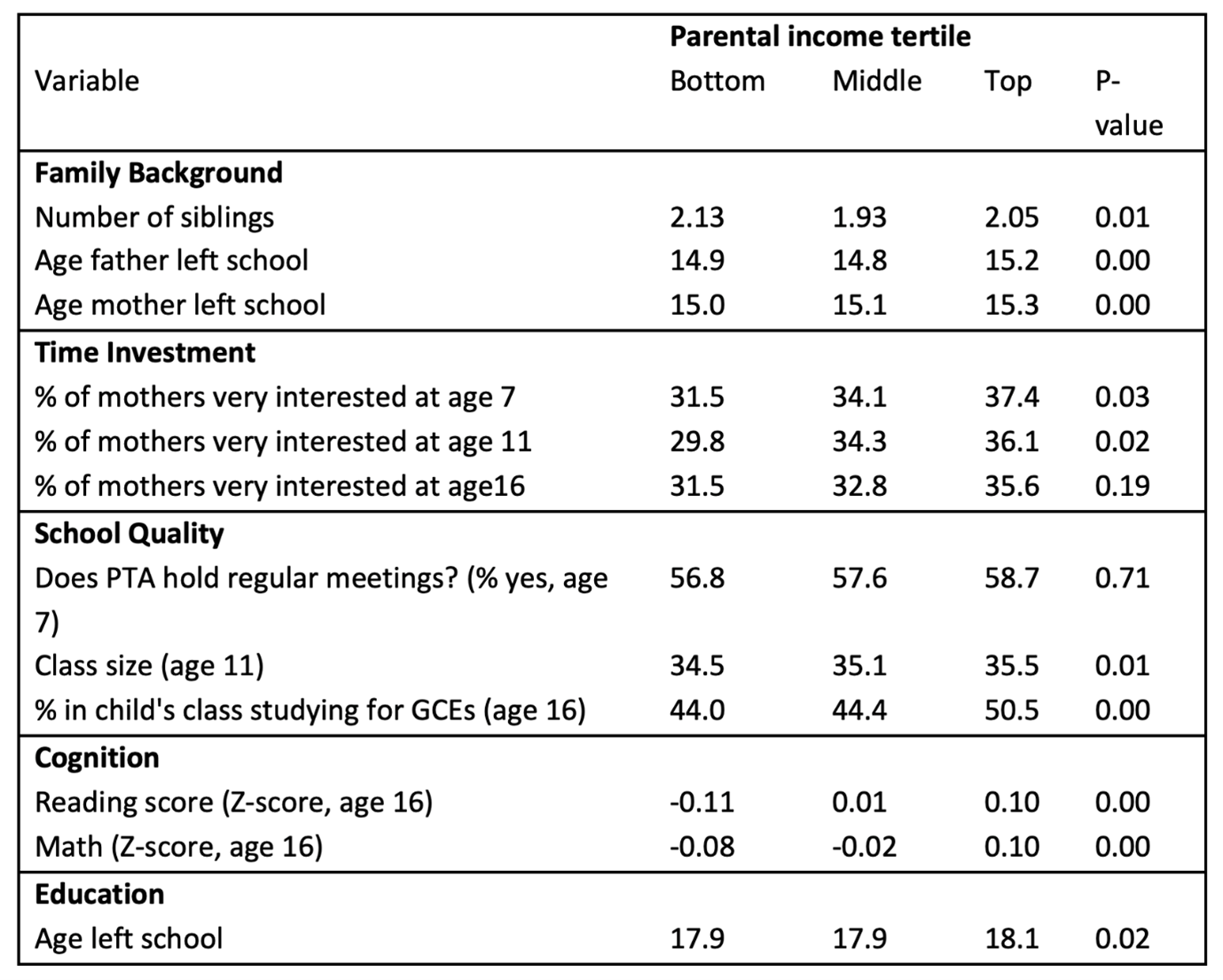
Table 1 shows gradients for some of our channels of interest by parental income tertile.  The table shows that children from high-income households have fewer siblings and more educated parents than those born to lower income parents. Teachers report that high-income parents are more interested in the education of their children.  Furthermore, children of high-income parents are more likely to go to schools where: parents attend educational meetings at age seven, student-teacher ratios are low at age 11, and a high fraction of students are doing GCEs at age 16 (an optional exam for progressing to further education).  As a result, children from richer households develop greater cognitive skills; at age 16, reading scores were 21% of a standard deviation higher on average for children with high-income parents compared to children with low-income parents.

Table 1 describes only a subset of the variables we use.  We combine these variables using a factor analytic approach to predict latent time investments, school quality and cognition, similar to Heckman et al. (2013).  The factor analytic approach allows us to use all measures available to us by treating them as noisy measures of school quality, parental time, and cognition.

Table 1 Sample means, by parental income

Table 1 Sample means, by parental income

Note: The final column reports P-values from the F-tests testing the null hypothesis of equality of means across parental income tertiles. The time investment measures are teacher-reported measures asked when the children are 7, 11, and 16. Teachers can evaluate parents as very interested, a little interested, not interested at all. We report the fraction of mothers and fathers who are very interested.

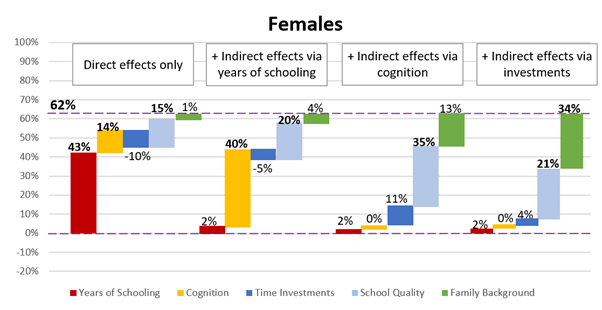
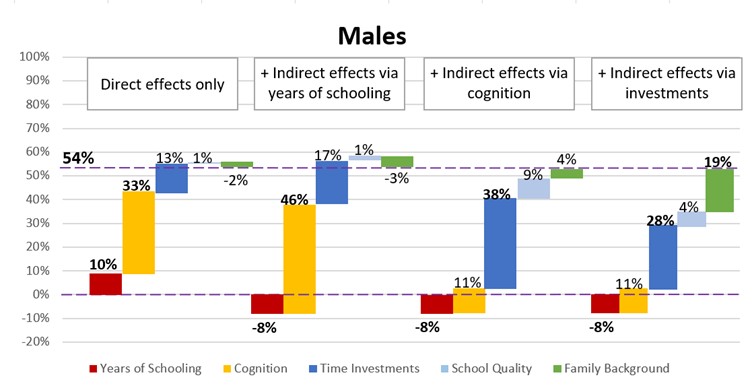
We find the intergenerational elasticity of earnings, or IGE (which is a measure of the relationship between parental and child lifetime income), to be 0.32 for men and 0.24 for women. The first part of Figures 1 and 2 shows the fractions of this relationship explained by differences in family environment, time investments, school quality, cognition at 16, and completed years of schooling when we only allow for direct effects of each variable on lifetime income. These variables explain over half of the IGE –– 54% and 62% for men and women, respectively (the remainder is explained by factors beyond the ones we consider, such as better job networks).

Figures 1 and 2 summarise the main for results for men and women respectively.

Figure 1

Figure 2

In the first panel of each figure, we find that years of schooling and cognition explain significant and large fractions of the IGE, both for men and women.  We then investigate whether schooling and cognition are driven by earlier life investments and family background.

In the second panels of Figures 1 and 2, we allow for indirect effects via years of schooling. For example, for cognition, we now additionally account for its effect on lifetime income via its effect on years of schooling. Doing so, we find that the fraction of the IGE that was previously explained by differences in years of schooling can actually be explained by differences in cognition, instead. This suggests that it is not parental income per se, but the higher cognitive levels of children of high-income parents that encourages higher educational attainment.

The next level of our analysis, illustrated in the third panel of each figure, addresses the sources of cognitive skills.  We allow for parental time investments, school quality, and family background to affect the IGE not just directly and via years of schooling, but also via cognition. We then find that the fraction of the IGE that comes from the cognition gradient can largely be explained by differences in time and school quality investments received during childhood. This is consistent with previous literature that has found significant effects of parental investments on cognitive development.

Lastly, we let family background – which comprises mother’s and father’s education, and number of siblings – have an indirect effect by affecting investments. Once we do so, family background explains 19% (34%) of the IGE for men (women). This contrasts with the zero effect of family background that we find in our baseline analysis. In other words, family background matters, but only because it affects investments, which then affect cognition and years of schooling. This result is consistent with Carneiro et al and Akresh et al. who find that increases in parental education lead to more favourable child outcomes. However, we also find that even if we control for family background, the remaining parental income gradient of investments explains 28% of the IGE. This suggests that higher parental income directly leads to higher investments in children, and not only runs through family background, a point which we have developed in greater detail in a forthcoming paper. This supports Bastian and Lochner’s (2021) conjecture that the increase in financial resources from programmes such as the Earned Income Tax Credit are what drives improvements in child outcomes.

Thus, we conclude that the main driver of intergenerational earnings persistence are differences in investments received during childhood which subsequently leads to improved cognition and more years spent in education.  Many of these investments, such as school quality, are the subject of public policy debate.  Our results suggest that policies that equalise these investments could improve income mobility.

The Intergenerational Elasticity of Earnings: Exploring the mechanisms, is research by Uta Bolt, Eric French, Jamie Hentall-MacCuish and  Cormac O’Dea.

Is inequality unfair?

by Paul Hufe, University of Bristol

Inequality is on the rise in many countries across the globe. The implications of these changes for social justice are hotly debated. In recent work, we have developed a new measure of unfair inequality and used this measure to study unfairness in the US and 31 European countries. We found inequality and unfairness had gone hand in hand in the US since 1980. Today, the US emerges as one of the most unfair societies in the West.

Do differences in incomes reflect discrimination and a lack of opportunity for social groups, or do the inequalities we can see simply reflect the just deserts of more or less hard-working individuals? Many of us have our own answers to these questions. However, to advance the broader debate and to discuss policy responses, we cannot rely on individual perceptions alone. Instead, we need to have a toolbox that allows us to compare the current state of the world with what we think a fair society should look like.

In our recent work we provided such a toolbox. To date, fairness discussions have mostly homed in on comparisons of inequality across countries and time. In these discussions Scandinavian countries typically emerge as paradisal islands of fairness whereas soaring inequality has made the US seem a kingdom of unfairness.

However, comparisons based on inequality alone do not tell us much about fairness. The reason is that the underlying measures for such comparisons condemn all inequality as unfair and cannot account for more nuanced perspectives on what fair societies should look like.

A new measure of unfairness

But how can we do better? In a first step, it was important to understand which types of inequality should be considered unfair. Therefore, we dug into the literature on political philosophy and behavioural economics.

Two contenders emerged. On the one hand, equality of opportunity. This principle states that inequalities are unfair if they caused by factors that are not the responsibility of individuals; think of inequalities across gender, race or the wealth of your parents. On the other hand, freedom from poverty. This principle states that inequalities are unfair if people cannot make ends meet; think of people that cannot buy enough food, shelter or clothing. In a second step, we needed to integrate these principles into measures.

To this end, we constructed income distributions of an “ideal” world, i.e. income distributions where there is equal opportunity for everyone and nobody is poor. Then we compared this “ideal” state of the world against the “actual” state of the world: the more the two states diverge, the higher the level of unfairness in society.

Unfairness in the US and Europe

What do we learn when from this new measure? We assessed trends of unfair inequality in the US from 1969 to 2014 and compared the US to 31 European countries in 2010. In the US, total and unfair inequality had both doubled since the beginning of the 1980s. This increase in unfairness was driven by less equal opportunities between children coming from more and less advantaged families.

Across countries, the US ranks among the most unfair societies. Notably the most unfair European societies in 2010 were Greece, Portugal, Spain and Italy – that is, those countries most strongly affected by the European debt crisis in 2010. In contrast to the US, unfairness in these countries was not driven by less equal opportunities but by increases in poverty.

Take-aways

In this work, we provided a blueprint for how to measure the unfairness of income inequality. We used this measure to study the US and Europe and showed that unfairness in the US has increased over time, putting it among the most unfair societies in the West. Our indicators may provide important information in current debates on the fairness of income inequality and potential public policy responses.

This work is only is a first step in a larger research agenda. Which factors should be considered responsibility factors? When is a person poor? Answers to these questions are far from obvious, but are indispensable for the measurement of unfair inequality. We hope that our work helps to guide these conversations by making the (un)fairness of income inequality more transparent and accessible to a larger audience.

Measuring Unfair Inequality: Reconciling Equality of Opportunity and Freedom from Poverty is research by Paul Hufe, Ravi Kanbur and Andreas Peichl and is published in the Review of Economic Studies. It has been produced as part of DIAL’s IMCHILD project.

Michael Grätz: Siblings and their incomes – the same or different over the life course?


In Episode 10 of the Dial Podcast, Michael Grätz from the University of Stockholm talks about sibling similarity in income and what that tells us about their life chances later on.  The research, which uses Administrative Data in Sweden and is published as a Working Paper, was also presented at the DIAL mid term conference in June 2019.

Transcript

Read more