Why rich parents have rich children

by Sreevidya Ayyar, Uta Bolt, Eric French, Jamie Hentall MacCuish, Cormac O’Dea

The children of rich families tend to go to better quality schools, have higher cognitive skills, and complete more years of schooling. This blog exploits unique data from the National Child Development study to determine these early childhood factors go on to have long-run impacts on an individual’s lifetime earnings, perpetuating a cycle of wealth. These results suggest that policies that equalise investments, such as improving school quality, could promote income mobility.

Rich parents have rich children. Why is that the case?

The children of rich families tend to differ from their poorer peers in multiple ways. They have fewer siblings and more educated parents. Their parents spend more time with them and send them to better quality schools. Their cognitive skills are higher, and they complete more years of schooling. All of these channels have been found to affect an individual’s earnings. However, in order to design policies to improve intergenerational mobility, we need to understand how these channels interact with each other in generating correlations in lifetime income across generations.

Take the example of school quality. Attending a high-quality school may have direct long-run effects on an individual’s lifetime earnings by creating a more valuable professional network, for example. However, attending a higher quality school can also have indirect effects on lifetime earnings through improved cognitive skills and/or the student staying in education for longer. Each of these channels are more likely to benefit the kids of richer parents, who tend to have access to better schools. In a new paper we use mediation analysis to quantify the different channels through which parental income can impact an individual’s lifetime income. We find that intergenerational earnings persistence is mainly explained by differences in investments received during childhood, which in turn drive differences in cognition, years spent in education, and ultimately lifetime earnings.

We exploit unique data from the National Child Development Study (NCDS), which initially surveyed families of the entire population of children born in one particular week in 1958 and has followed them up until today.  The NCDS contains rich information on: family income and circumstances during childhood, indicators of quality time that parents spent with the children, proxies for the quality of schools that they attended, measures of cognitive skills, as well as final educational outcomes and earnings throughout the lifecycle.

Table 1 shows gradients for some of our channels of interest by parental income tertile.  The table shows that children from high-income households have fewer siblings and more educated parents than those born to lower income parents. Teachers report that high-income parents are more interested in the education of their children.  Furthermore, children of high-income parents are more likely to go to schools where: parents attend educational meetings at age seven, student-teacher ratios are low at age 11, and a high fraction of students are doing GCEs at age 16 (an optional exam for progressing to further education).  As a result, children from richer households develop greater cognitive skills; at age 16, reading scores were 21% of a standard deviation higher on average for children with high-income parents compared to children with low-income parents.

Table 1 describes only a subset of the variables we use.  We combine these variables using a factor analytic approach to predict latent time investments, school quality and cognition, similar to Heckman et al. (2013).  The factor analytic approach allows us to use all measures available to us by treating them as noisy measures of school quality, parental time, and cognition.

Table 1 Sample means, by parental income
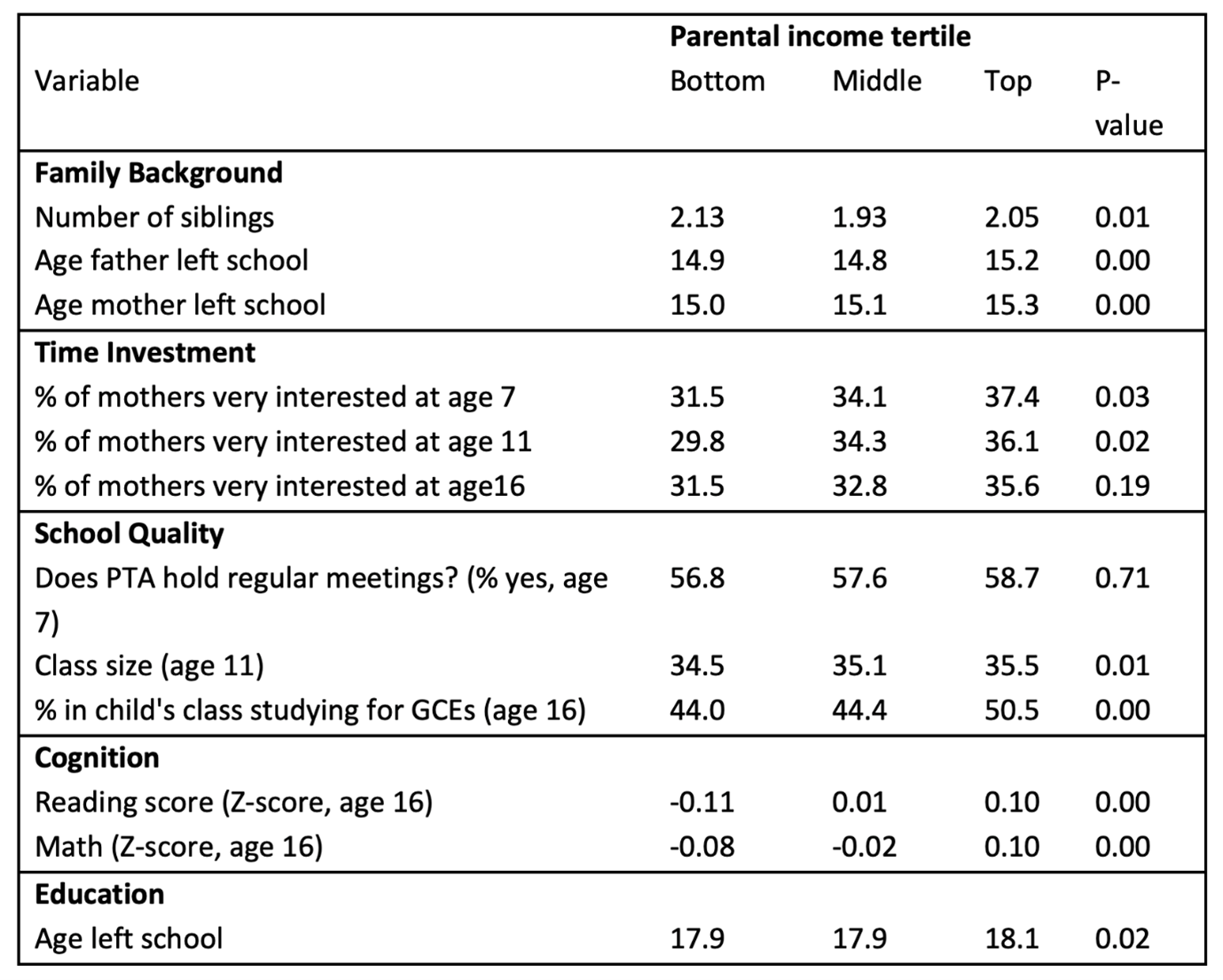
Table 1 Sample means, by parental income

Note: The final column reports P-values from the F-tests testing the null hypothesis of equality of means across parental income tertiles. The time investment measures are teacher-reported measures asked when the children are 7, 11, and 16. Teachers can evaluate parents as very interested, a little interested, not interested at all. We report the fraction of mothers and fathers who are very interested.

We find the intergenerational elasticity of earnings, or IGE (which is a measure of the relationship between parental and child lifetime income), to be 0.32 for men and 0.24 for women. The first part of Figures 1 and 2 shows the fractions of this relationship explained by differences in family environment, time investments, school quality, cognition at 16, and completed years of schooling when we only allow for direct effects of each variable on lifetime income. These variables explain over half of the IGE –– 54% and 62% for men and women, respectively (the remainder is explained by factors beyond the ones we consider, such as better job networks).

Figures 1 and 2 summarise the main for results for men and women respectively.

Figure 1
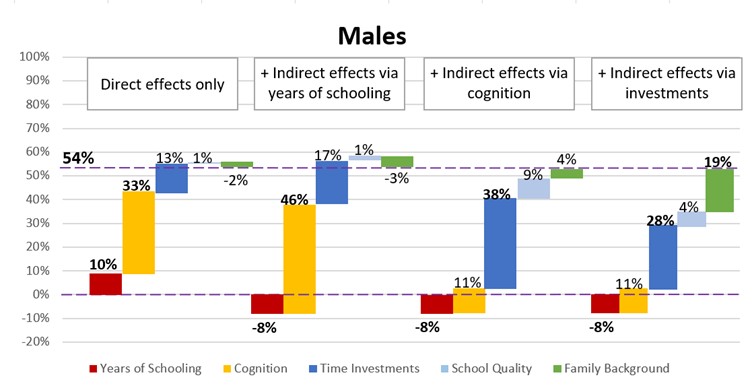
Figure 2
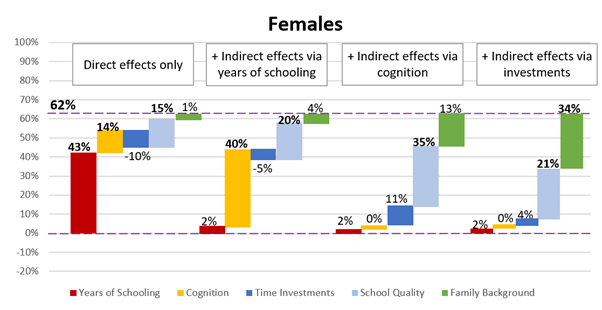
In the first panel of each figure, we find that years of schooling and cognition explain significant and large fractions of the IGE, both for men and women.  We then investigate whether schooling and cognition are driven by earlier life investments and family background.

In the second panels of Figures 1 and 2, we allow for indirect effects via years of schooling. For example, for cognition, we now additionally account for its effect on lifetime income via its effect on years of schooling. Doing so, we find that the fraction of the IGE that was previously explained by differences in years of schooling can actually be explained by differences in cognition, instead. This suggests that it is not parental income per se, but the higher cognitive levels of children of high-income parents that encourages higher educational attainment.

The next level of our analysis, illustrated in the third panel of each figure, addresses the sources of cognitive skills.  We allow for parental time investments, school quality, and family background to affect the IGE not just directly and via years of schooling, but also via cognition. We then find that the fraction of the IGE that comes from the cognition gradient can largely be explained by differences in time and school quality investments received during childhood. This is consistent with previous literature that has found significant effects of parental investments on cognitive development.

Lastly, we let family background – which comprises mother’s and father’s education, and number of siblings – have an indirect effect by affecting investments. Once we do so, family background explains 19% (34%) of the IGE for men (women). This contrasts with the zero effect of family background that we find in our baseline analysis. In other words, family background matters, but only because it affects investments, which then affect cognition and years of schooling. This result is consistent with Carneiro et al and Akresh et al. who find that increases in parental education lead to more favourable child outcomes. However, we also find that even if we control for family background, the remaining parental income gradient of investments explains 28% of the IGE. This suggests that higher parental income directly leads to higher investments in children, and not only runs through family background, a point which we have developed in greater detail in a forthcoming paper. This supports Bastian and Lochner’s (2021) conjecture that the increase in financial resources from programmes such as the Earned Income Tax Credit are what drives improvements in child outcomes.

Thus, we conclude that the main driver of intergenerational earnings persistence are differences in investments received during childhood which subsequently leads to improved cognition and more years spent in education.  Many of these investments, such as school quality, are the subject of public policy debate.  Our results suggest that policies that equalise these investments could improve income mobility.

The Intergenerational Elasticity of Earnings: Exploring the mechanisms, is research by Uta Bolt, Eric French, Jamie Hentall-MacCuish and  Cormac O’Dea.

Why and how do rich parents have rich children?

In Episode 12 of Series 3 of our podcast, Jamie Hentall MacCuish from University College London and the Institute for Fiscal Studies discusses findings  from DIAL’s TRISP project on the intergenerational elasticity of earnings or why rich parents have rich children. 

The Intergenerational Elasticity of Earnings: Exploring the Mechanisms is a DIAL Working Paper. 


Transcript

Christine Garrington 0:00

Welcome to DIAL a podcast where we tune in to evidence on inequality over the life course. In series three we’re discussing emerging findings from DIAL research. For this episode, we’re talking to Jamie Hentall MacCuish from University College London and the Institute for Fiscal Studies. He’s been investigating why rich parents have rich children. I started by asking him to explain the background to the research.

Jamie Hentall MacCuish 0:26

If you will permit me I think it’s a bit hard to answer that question without very quickly saying what the paper is about. So in it, we decompose the intergenerational elasticity of earnings or the IGE, which is the correlation between parents and children’s earnings. And we do this to try and understand what mechanisms transmit privilege from one generation to the next. We were using this dataset – the national cohort data study or NCDS – for another paper with a slightly different focus, and we realised the data set offered a unique window into the mechanisms affecting the IGE. Now the NCDS follows a single cohort of people born in a particular week in 1958. From the moment of their birth, up until now as they approach retirement. And it really is a globally unrivalled resource for social scientists due to its combination of information about family background, parental effort and time investment in their children and children’s ability, educational outcomes and later life earnings. Having this information allows us to disentangle the relative importance of family background parental investments in children, further education and ability in explaining the correlation between parents’ and children’s earnings. Now, I mean, I’ve said it’s a globally unrivalled data set what really makes it globally unrivalled is how forward looking this policy was in 1958. I mean, other countries have since introduced similar datasets, but much later meaning that now we don’t have data that covers really most of the working life of these group of individuals, which really makes it a fascinating window into what explains that intergenerational correlation in earnings or IGE.

Christine Garrington 2:10

What exactly was it about having wealthy or poor parents that you wanted to get to grips with specifically in this piece of research?

Jamie Hentall MacCuish 2:19

Why wealthy parents have wealthy children and vice versa? So the children of rich families tend to differ from the poorer peers in multiple ways. They have fewer siblings and a more and more educated parents, their parents spend more time with them and send them to better quality schools. Their cognitive skills are higher at the end of compulsory education, and they complete more years of total education. All these channels have been found to affect an individual’s earnings. But in order to design policies to improve intergenerational mobility, we need to understand the relative importance of these channels and how they interact with each other to generate correlations in lifetime earnings.

Christine Garrington 3:00

Okay, so what did you actually do then once you know, once you sort of started digging into the data, what did you actually do?

Jamie Hentall MacCuish 3:06

A multi-level mediation analysis. Basically, that means we work backwards to see how much of the IGE is explained by each mechanism. So that’s probably pretty cryptic. But in the first level, that we started at we only allow for direct effects on a child’s earnings of the years in education, their cognitive ability, the quality of the school they attended, and the parental investment they received and their family background. So in this first level, for example, we find that education accounts for 43% of the IGE amongst females. However, in the next level, we account for the fact that other channels refer to events earlier in the child’s life, than total years of education because really, total years of education is determined by further education decisions. And so other events plausibly impact on the years of education. Once we account for both the direct effects as well as these indirect effects through years of education, the fraction of the IGE explained for females by education collapses to just 2% to continue with the example given earlier, and cognitive abilities at the end of compulsory schooling really explained most of this difference.

Christine Garrington 4:22

Can you help us unpack that a little bit Jamie? What does that actually imply?

Jamie Hentall MacCuish 4:25

Once you account for cognitive ability at the end of compulsory schooling, the fact that children of richer parents spend longer in education doesn’t account for much of the persistence in earnings between generations. And then we then extend the analysis back to more levels to account for the fact that parental investments and stalling might, like school quality, might impact cognitive ability at 16. And that family background might impact parental investment decisions, or the parents’ choice of school.

Christine Garrington 4:52

You mentioned a little bit earlier about, you know, the amazing data resource that the NCDS is. Are we able to sort of tease out a little bit more about the sorts of things that people are asked in that study that would help you with, with this research?

Jamie Hentall MacCuish 5:07

There are multiple things asked and multiple tests. So it’s not just survey questions. There were tests; reading tests, math tests administered to these children in schools. They measure their weight at birth, the researchers went into the children’s school and ask the teacher their impressions of how interested the mother and father are in the child’s education. With, it was asked how many outings the parents took their children on, and these are I mean, we combine all of these measures about parental investments into sort of using a latent factor analysis to tease out a measure of how much the parents invest in their children. And similarly, with the child’s ability, we have measures of reading scores, math scores, and then teacher ratings of these children on maths and reading ability. So I mean, it’s it’s a very, I could go on. It’s a very, very rich data set. And it’s yeah, it’s not just survey data. It’s tests administered medical information. Yes, it’s really quite detailed.

Christine Garrington 6:11

You’ve touched on this a little bit already. But when you looked at the data what were the key differences? Tell us more about the key differences that emerged between the children of wealthier and poorer parents.

Jamie Hentall MacCuish 6:23

The children of richer families tend to differ in multiple ways from their poorer counterparts: fewer siblings, more educated parents, better parental time investments and school quality investments, higher cognitive skills, and more years of total education. But for us, that was really just the jumping off point to then analyse which of these differences matter most to explain this correlation of earnings between parents and generations from this persistence of inequality from one generation to the next.

Christine Garrington 6:51

And you took into account obviously a range of other factors as well what factors mattered most in all of this and how did they play out?

Jamie Hentall MacCuish 6:59

So once we accounted for all the levels of analysis, so the for the effect of a family background and early investment on cognition and years of education, what we found is that family background and investment in early childhood mattered the most, the relative importance being different for men and women. For women, the most important was family background followed by school quality. And for men, parental time investment mattered most followed by family background.

Christine Garrington 7:24

So this is all very interesting, but I’m wondering now you know what are the important takeaways from the research about this relationship between how well off a parent is and their child’s life lifetime income prospects, for example?

Jamie Hentall MacCuish 7:38

It simply what factors we found mattered most? It seems that to explain the persistence of inequality in earnings across generations, early childhood investments and family background really matter the most. And higher educational choices, for example, aren’t one of the mechanisms generating persistence in inequality in earnings across generations.

Christine Garrington 8:02

Right, I wonder if there’s any more to say there about from a policy perspective, if you like for those committed to want to seek and create a more equitable, a fairer playing field for all children, regardless of their background and how rich their parents are, what sorts of things are most relevant? Are they the things that you’ve outlined already? Or is there anything more that they can take away from this?

Jamie Hentall MacCuish 8:21

Obviously, you want to be careful making too many policy suggestions off one piece of research, but that said, I think our research really is in alignment with a large and growing literature that says early childhood investments are one of the best levers available to reduce intergenerational inequality. I think anything the government, our research would say and so I think with a large growing body of research say, that anything government could do to reduce the inequality in investments in early childhood would be one of the most powerful mechanisms to reduce intergenerational inequality.

Christine Garrington 8:56

The Intergenerational Elasticity of Earnings: Exploring the Mechanisms is a DIAL Working Paper by Uta Bolt, Eric French, Jamie Hentall MacCuish and Cormac O’Dea from the Trends in Inequality: Sources and Policy or TRISP project . You can find out more on the DIAL website at dynamicsofinequality.org. Thanks for listening to this episode of our podcast, which was presented by me, Chris Garrington and edited by Elina Kilpi-Jakonen.