How does economic disadvantage accumulate for single mothers?

In Episode 7 of Series 2 of our podcast we talk with Professor Susan Harkness from the University of Bristol and PI of DIAL’s EQUAL LIVES project about how economic disadvantage accumulates for single mothers and the impacts on their income and risk of poverty of having a child and splitting up from a partner.


Transcript

Christine Garrington  0:00

Welcome to DIAL a podcast where we tune in to evidence on inequality over the life course. In this series, we discuss emerging findings from DIAL’s Equal Lives project. Our guest today is Professor Susan Harkness from the University of Bristol and PI of Equal Lives. She’s been looking at how economic disadvantage accumulates for single mothers, and the impacts on their income and risk of poverty of having a child and splitting up from a partner. I started by asking her about the background to her research.

Susan Harkness  0:28 

I think for a long time, there’s been an assumption that single mothers are more likely to be poor or living in low income because they’re not living with a male breadwinning partner. And I think one of the things that’s been much less well recognised is that in the US, but also elsewhere, single mothers are much more likely to be poor than single fathers and I think one of the reasons for this is not just that they don’t live with a partner, but also because they face an enormous economic hit because of motherhood. And I think the motherhood penalty. We know, we know it exists. We know mothers are much less likely to work than fathers. And when they do work, that they’re more likely to be paid less. And what I wanted to do was try and connect to this research with research from single parenthood to see what the impact on single mothers’ incomes was.

Christine Garrington  1:16 

So what was it here that you wanted to look at specifically and why then?


Susan Harkness  1:21 

Okay, so I wanted to think about why single mothers were more likely to have low income so what was the penalty to single motherhood? And in doing that, I wanted to think about single motherhood is a process that sort of evolves over the life cycle. So first of all, we know that mothers when they have children, they face this economic penalty in the labour market, and then when they separate, they’re left in this very vulnerable position because their employment earnings have just declined so much.

Christine Garrington  1:49

And for this research, where did you get your information from? And can you tell us sort of why it is a good source for for looking at these particular issues? 

Susan Harkness  1:58 

Yes, so we looked at data from the Panel Study for Income Dynamics and it’s a great source of data because it allows us to look at people over time. In the case of our study, we’ve followed them for over 10 years, since becoming mothers to look at what happened to their incomes around these kind of critical lifecourse transitions. One of the great advantages of it is that we can see how people were doing before they became single mothers and we can see how they were doing after and then we can kind of look at how each of these different life course events – motherhood, partnership dissolution – leads to changes in their economic circumstances. Another major advantage of this data is that it’s got a really large sample size, and therefore we can think a bit more also about the heterogeneity the experience of single mothers. And what we mean here is that we can think about whether all single mothers effectively look the same or whether different routes into single motherhood have a different impact on their incomes. So what we did in this particular case was think about how single mothers differ according to whether they were previously married. They were previously cohabiting, or indeed they were married at the time at which they had a child. And this is a group which is accounting for a sort of growing share of births in the US and indeed in the UK over time.

Christine Garrington  3:18 

Right now you started by comparing the incomes of single, cohabiting and married mothers, what did you, what did you actually see there?

Susan Harkness  3:26

So one thing that we see is, is I think fairly fairly well known but we know that for example, married mothers start from a position of having higher incomes than cohabiting mothers and single mothers. So there’s an income gradient with cohabiting mothers sitting somewhere in the middle. But what we also know is that the, the income composition of those families is quite different. So whilst in single mother families, women are indeed largely dependent on their own earnings, and to some extent on benefit receipts, in cohabiting and married mother families, there’s a much greater dependence of women on partner’s earnings. And indeed if you look at the earnings, of women within those different family types, they’re actually relatively similar. Married and cohabiting mothers tend to be more dependent on partners, whereas single mothers tend to be more dependent on their own earnings and on the state. 

Christine Garrington  4:22

Yeah, right – so what was the earnings impact of divorce or separation for each of these groups and were they larger for some than, than others?

Susan Harkness  4:29

Okay, so one of the things that we thought was really interesting is that if we look at what happens to women’s own earnings following the birth of a child, the biggest negative effect was for women who were previously married. So we’re not looking at wage effects specifically we’re looking at the combined effect of changes in wages and changes in working hours and indeed participation. What we see is that for married mothers, we find much greater reduction in self-sufficiency or increased economic dependence as a result of childbirth, amongst cohabiting mothers, among single mothers, we see a smaller earnings effect, so earnings declined by less. And what happens then if we look at the income within those families, is that if we consider what happens to the income of married mother families? In fact, what we find is that although earnings fall quite substantially amongst married mothers, these are compensated for by increases in fathers’ earnings who to tend to work longer hours and work more often when they have a child and therefore the overall impact on income is relatively small, whereas in single mother families, the birth of the child is associated with the fall in earnings and a really large impact on overall income.

Christine Garrington  5:42

Okay, and you also considered how the loss of a male partner’s income affected these separated and divorced mothers, what did you see there?

Susan Harkness  5:49

So what we see for the loss of a partner’s earnings is of course, married mothers tend to be partner to higher earning men and men who work more following the birth of a child and so when the partner leaves, we have a larger negative effect on their overall incomes. And part of this is because of the reduction in these married mothers’ own earnings following childbirth. And part of the reason for that is that the, they have, they have farther, further to fall. So the, the loss of father’s earnings fall this is somewhat greater.

Christine Garrington 6:19

Yeah, so quite a lot of information there. What do we learn from all of this? That’s new, Susan?

Susan Harkness  6:24

If we think about what happens within married couples, I think because marriage sort of provides some security, is thought to provide some security for those who have children that we tend to see greater levels of specialisation within those households. What this means is that women see their earnings fall farther than cohabiting are single mothers, and it becomes harder for them to recover those earnings should they, should they separate so the overall impact should they become single mothers on their own labour market income is greater than for these other family types. And what does this mean? It means that actually the separation from marriage tends to have worse consequences than it does if you become a single mother through separation from cohabitation or divorce. Whilst you might think, for example, that maintenance might help offset some of these costs associated with divorce. In fact, this is often not really, not really the case because the levels of maintenance payments are relatively small. What we find is actually that single parenthood, regardless of the route in by which you become a single mother, is really quite a leveller and women who were better off before see the largest falls in their income.

Christine Garrington 7:42

Okay, there was one other aspect of your research that really caught my eye and this was, these were your findings around what things are like for single moms who are living with parents. These are quite interesting, weren’t they?

Susan Harkness  7:51

Oh, I think this is, this is fascinating. So one of the things that I think increasing research is looking at is how, how single mothers maintain those sort of standard of, standard of living, when they’re not able to rely on their own earnings or indeed on the state. And we know that in the US around one in 10 single mothers are living with their own parents. And in in this study, we find that actually living with your own parents is a really important mechanism for boosting families’ income. And in fact, living with your own parents provides as much protection for household income as being married and a little more than if you find a new partner, for example. So it’s really, really important living with grandparents is a really important route to kind of maintaining your standard of living following parental separation. 

Christine Garrington 8:42

Important to acknowledge that the very rich data you used here is from the US but I wonder if you think that the picture might be reflected in the in the UK, where we are, and also possibly in other parts of Europe?

Susan Harkness  8:54

Yes, absolutely. So one of the things we know about the UK is that and indeed other parts of Europe is that motherhood is associated with even larger reductions in overall labour supply. So we know that women when they have children are perhaps less likely to work but also much more likely to work part-time. So the the numbers that are working full time are far lower, after having children in the UK and other European countries, many other European countries than in the US. So what we would expect to find is actually that the impact of single motherhood on income is going to be quite different. So in the case of in the case of the UK, what we might expect to see is that it sees large losses in earnings associated with losses in employment for motherhood, are probably going to have an even larger impact on their well being – their economic well being – should they, should they subsequently divorce. But on a more sort of positive note, I think what we have in many European countries is greater welfare support for, for single mothers which is, is much more significant for boosting their incomes. Although of course this has the further drawback that it can also discourage women from working or working longer hours because of the design of various welfare support systems.

Christine Garrington 10:18

Yeah, indeed. Now single mothers are a key area of interest for you as a researcher but also a really important group of people that policymakers are interested in and your research would seem to have quite clear and important ramifications and implications for welfare policy. Could you talk us through what you think those modifications are?

Susan Harkness  10:40

Yeah, so I think what one of the things we often see focused on when we think about single parents is what to do about father absence, in particular, how to make fathers pay maintenance, for example. But what our findings are suggesting is that actually, when we think about how to support single mothers incomes, we need to go much further than that. And in particular, one when we think about, for example, welfare to work policies, which focus on single, single mothers. It’s really the case that in my view, that these policies are something that happened far too late in the life course. So if mothers have already lost their jobs and their earnings potential has already been weakened as a result of motherhood, then trying to do something about that at the point at which they divorce seems to me to be far too late. If we look at other studies, more recently, they suggest that when mothers do well, those in single parent families do well as well. And if we think about policies to ensure that women are able to maintain their economic position after having children in the labour market, then we would want to think much more widely about policies such as childcare provision, which would allow mothers to work, reduce their economic dependence and improve their prospects should they separate.

Christine Garrington  12:00 

“Accumulation of economic disadvantage: the influence of childbirth and relationship breakdown on mother’s income and poverty risks” is research by Susan Harkness and is published in Demography. You can find out more about the Norface funded Equal Lives project at Equal-lives.org, and about the wider DIAL programme at dynamicsofinequality.org. Thanks for listening to this episode of our podcast which is presented and produced by Chris Garrington, edited by Elina Kilpi-Jakonen.

The Accumulation of Economic Disadvantage: The Influence of Childbirth and Divorce on the Income and Poverty Risk of Single Mothers is research by Professor Susan Harkness of the University of Bristol and is published in Demography.
How does economic disadvantage accumulate for single mothers?


In Episode 7 of Series 2 of our podcast we talk with Professor Susan Harkness from the University of Bristol and PI of DIAL’s EQUAL LIVES project about how economic disadvantage accumulates for single mothers and the impacts on their income and risk of poverty of having a child and splitting up from a partner.

The Accumulation of Economic Disadvantage: The Influence of Childbirth and Divorce on the Income and Poverty Risk of Single Mothers is research by Professor Susan Harkness of the University of Bristol and is published in Demography.


Check out this episode!

The dynamics of inequality: what have we learned?

In the final episode of the DIAL podcast we’re looking at what’s been learned from DIAL projects about how and when inequality manifests in our lives and what its longer term consequences might be. We’re joined by Elina Kilpi-Jakonen from the University of Turku in Finland. Elina is the Scientific Coordinator for DIAL and, as the programme draws to a close she reflects on some of the programme’s highlights,  key findings and implications for the future.  

Transcript

Christine Garrington  0:00 

Welcome to DIAL a podcast where we tune in to evidence on inequality over the life course. In series four, we’re looking at what’s been learned from DIAL projects about how and when inequality manifests in our lives, and what its longer-term consequences might be. For this final episode of the series, we’re delighted to be joined by Elina Kilpi-Jakonen, from the University of Turku in Finland. Elina is the scientific co-ordinator for DIAL and today, as the programme draws to a close, she’s here to reflect on some of the program’s highlights, key findings and implications for the future. So welcome, Elina thank you very much indeed, for joining us. Now, first of all, I’m guessing it’s been no mean feat and indeed, I know, it’s been no mean feat, keeping an eye across 13 fantastic research projects with researchers based all over Europe. But just take a minute or two, if you would to remind us of what exactly the DIAL programme is and what it’s involved over the last few years.

Elina Kilpi-Jakonen  0:57 

So thanks a lot, Chris. The DIAL programme is, as you said, kind of transnational programme. And we’ve had 13 research projects involved. And all of those involve international collaboration. And it’s based in the social sciences and behavioural sciences, financed by NORFACE, which is a research organisation bringing together different funding institutes across Europe. And so the focus of DIAL has been on inequality and in particular inequality across the life course and trying to understand some of the structures of inequality cross nationally and some of the mechanisms kind of producing inequality and and what that means to people and societies as a whole.

Christine Garrington  1:41 

Wonder if I can ask you why it has been so important to look not just at inequality, per se, as you were saying there, but at how inequality manifests itself over the life course, because this is an important thing, isn’t it? And indeed how, when and where it sort of accumulates?

Elina Kilpi-Jakonen  1:57 

Inequality is a really complex and multifaceted issue. And so I think one one part of it is that inequality comes across in many different domains. So it’s important to take into account inequalities, for example, in education, labour market, health, and so on. And then I mean, to really understand where it comes from and what it means it’s important to look at the determinants across time, I mean, both across time for an individual and their parents, and so on, kind of that life course aspect, but also, for countries to see how it develops across time. Inequality isn’t something that just is, I mean, it develops. And so kind of building on that kind of developmental process to really kind of inform us about how we can do something about it, or how we can really kind of understand where it comes from, it’s important to take that into account.

Christine Garrington  2:58 

Now, you talked about the programme largely being based in the social sciences. But one of the key things about the project is that we’ve seen researchers from different disciplines as well as different countries coming together to try to tackle, as you say, as you rightly say, this incredibly complex area around inequality, what’s been the thinking there?

Elina Kilpi-Jakonen  3:20 

Well, I mean, inequality is something that interests a lot of academics working in different disciplines. And, and they come from it from from kind of different angles. And I think, because it is kind of a complex issue, and it’s an issue that kind of manifests itself in different ways. So really building on on the strengths of different disciplines, I think is a key key strength here. So we don’t only look at inequality in one domain, for example, say, say something like education, which would then be kind of a subset of disciplines that tend to be interested in inequality in education, but also how education is linked to inequalities in in other aspects and, and in addition to the kind of different domains that come from different disciplines, also, the ways in which we, we analyse it and building on the strengths and knowledge of different disciplines. I think is key here, key to, to just building a comprehensive picture and learning from each other, as well as as then taking that knowledge forward.

Christine Garrington  4:34 

It would be remiss of us not to talk about COVID. And in some ways, it was something of a setback for plans to to stage events and meetings around the the programme of research to get the word out there about it. But it also provided in some respects, a rather unexpected opportunity, didn’t it to use the programme to look at inequality in the context of COVID. So, so tell us a bit about that.

Elina Kilpi-Jakonen  4:58 

Yeah, so obviously the research programme began before COVID. And so the projects had their their kind of plans of what they wanted to do and the analysis that they were going to do. But given this massive impact that COVID had on on society and and on inequality as well. A lot of projects then decided that this would be a really important aspect to look at and an opportunity also to learn about inequality in a changing societal context. So different projects have taken this into account in different ways. But for example, there’s been kind of really important work on on just what happened to inequality for example, due to lock down and and the economic upheaval of COVID, not just the health implications, but then also using that upheaval, to think about how inequalities might be changed. And for example, so work by Alejandra Rodríguez Sánchez, Suzanne Harkness and Anette Fasang, looking at what happened to housework, during COVID. People were having to stay at home, both parents and children and seeing what happens to inequalities between men and women. And how the, the the number and age of children influences that and kind of what they saw was that obviously, this change in in family habits changed house work habits, but at the same time, when locked down ended a lot of couples returned to normal. So so even though there was a massive shift, and and people behaved differently for a short period of time, we can see that these kind of entrenched habits, then then go back to normal quite quickly.

Christine Garrington  6:43 

Yeah, really interesting piece of work that so. And also, despite COVID, you were able to, nevertheless, to involve a great number of stakeholders in in the research, what messages did you receive from them, I wonder about what was emerging?

Elina Kilpi-Jakonen  6:58 

So yeah, we’ve had some really interesting discussions with stakeholders, both policymakers and then kind of non-governmental organisations involved in both practical work and lobbying as well. And they’ve been really interested in in the work that we’re doing. So in particular, we’ve talked to stakeholders involved in kind of gender inequality work, and how participation in the labour market is unequal between men and women, and in particular, between mothers and fathers. And then we’ve also talked a lot to stakeholders involved in kind of childhood disadvantages, and how different types of children are put at a disadvantage. And what are some of the mechanisms kind of potentially either alleviating those disadvantages, or that are currently making those disadvantages larger, and that would kind of be important to look at. So we’ve kind of talked both about the the bigger picture of inequality, but also some of the mechanisms and obviously, stakeholders are, are often interested in what they can do. And then we’ve also had really good discussions about especially with policymakers also about the kinds of data that going forward, would be needed to, to kind of really analyse these things further. And I think there’s a lot of kind of shared interest in collecting data or making administrative data available for researchers to be able to address inequalities in the future.

Christine Garrington  8:28 

Yeah, now a major part of your role, Elina has been to pull together all of these different strands of work in some way to ensure that we get to a, what we hope is a coherent picture of what’s been learned from the programme as a whole. And I wonder whether it’s possible in the short period of time that we have to say what has been learned from the programme as a whole?

Elina Kilpi-Jakonen  8:48 

Well, that’s no mean feat. To then kind of say what’s been learned because I think there’s such richness in the research coming through and I mean, we’ve only kind of touched upon some of the aspects just now. And so we what we’ve been trying to do is, is bring together kind of thematically, things we’ve learnt in terms of, for example, gender inequalities, as I just mentioned. So So really looking at further at kind of motherhood, penalties and how, how those might be potentially for example, by by further training ameliorated although at the same time, we need to remember that women tend to nowadays have higher education levels than men. So education isn’t always the key here. So also looking at kind of gender and sexual minorities, even though we’ve been making progress in terms of legislation and policy. The discrimination can still be kind of an ongoing issue for people and and kind of the legacy of the past is still a major issue for for LGBT citizens across Europe and even though legislation has progressed a lot to still the practices in terms of, of workplaces or educational institutions aren’t aren’t really catching up necessarily, to such a large extent. And then moving on to kind of a different area, I think there’s been a lot of really interesting work in terms of, of the role of genetics, which is a big new area of research in terms of social sciences, and how that plays into the reproduction of inequalities across generations and over the life course, and how that changes depending on the environment that people live in. So, so we’re learning a lot about so called gene environment interplay, and which is obviously kind of something that social scientists are really keen to look at is the the environmental aspect of, of how genes play out. So so we’re learning a lot about the fact that genes aren’t our destiny as such, but but the the context or the environment matters a lot for that.

Christine Garrington  11:00 

Yeah, lots of really fascinating and very, very innovative work that’s going on in that area, for sure. Now, you’re talking about stakeholders a moment ago, you’ve been responsible also for helping to ensure the dissemination of this research to to those non-academics as well as other researchers. So I’m interested to know and I think others will be interested to know what sorts of resources there are available. For those interested to know more, aside from the obviously, the dozens, and I know, there are dozens of journal articles and working papers that have have been produced if you’d like for the scientific community. But what else is there.

Elina Kilpi-Jakonen  11:34 

Starting from those journal articles, I think we’ve tried to make a kind of effort to make those more accessible in terms of both bringing them all to our website, but also providing summaries that are not just the academic abstract. So even looking at the journal articles, starting from from summaries that are more accessible to everyone involved, and not just researchers in those fields, I mean, abstracts can sometimes be a bit difficult to disentangle. Then bringing together the research we’ve we’ve been producing policy briefs that, I mean, obviously are aimed at policy audiences but I think those bring together thematically some of the research as well in a really nice way. So those are available on the on the website, then obviously, this podcast series, I think is has been a great way of disseminating the research. In addition to that, so we had our final conference last autumn. And some of those videos from the presentations are available still through the website. I mean, there’s both recordings of presentations that bring together entire projects, but also kind of individual, more finely specified research topics. But But in particular, there’s there’s videos of researchers presenting their whole project at the final conference. So I think those are also a great resource.

Christine Garrington  12:57 

Yeah, indeed, a wonderful library of materials that people can dip into at their leisure and really catch up on and get to grips with the important things that have emerged from this, this work. So finally, Elina, the ultimate aim of a programme like this is obviously to improve our understanding and knowledge on the one hand and influence change for the good with the understanding on the other. And I wonder if you’re able to say how, I know it’s very difficult, but if you can say how all this important work might feed into the thinking and policies of those seeking to reduce inequalities today, and in the future?

Elina Kilpi-Jakonen  13:32 

At the same time as advancing academic knowledge, we definitely have wanted these research results to be relevant for policymakers and to reach policymakers and indeed, kind of other organisations interested in in these types of inequalities and processes. I mean, on the one hand, there has been really great comparative work on the kind of institutional influences that policies in different countries have and I think that’s a really important thing to draw from in terms of, for example, education policy, or family policies for work life balance and the gender inequality in pay so, so looking at the across national differences and comparing countries and then learning from that. But then also, I mean, there’s been really detailed work into kind of the mechanisms of inequality and more specific interventions for example, and how those influence inequality and and then really digging more deeply into how inequality is reproduced and what we might be able to do about that. So for example, work on on parenting and how that reproduces inequalities among children and and then thinking about well, how we might be able to to provide more equitable parenting for children and what we can do about that. So I think there’s, there’s been work on multiple levels that hopefully we’ll be able for policymakers to draw on in terms of developing these things in the future.

Christine Garrington  15:07 

Thanks to Elina Kilpi-Jakonen, DIAL’s scientific co-ordinator for joining us for the final episode of this fourth series of the DIAL podcast. You can find all the resources that Elina mentioned in this episode on the DIAL website at www.dynamicsofinequality.org. We hope you enjoyed this episode, which is produced and presented by Chris Garrington of Research Podcasts. And don’t forget to subscribe wherever you find your podcasts to access all our earliest series.

A level playing field for children: why it matters in tackling inequality over the lifecourse

In Episode 5 of Series 4 of the DIAL Podcast we’re in conversation with Andreas Peichl, Professor of Macroeconomics and Public Finance at the University of Munich and Principal Investigator of a DIAL project looking at the impact of childhood circumstances on individual outcomes over the life-course (IMCHILD). 

Pre-term children: how do they get an equal chance to thrive?

In Episode 4 of Series 4 we’re talking to Professor Sakari Lemola from the University of Bielefeld and formerly from the University of Warwick. Sakari is one of the Principal Investigators of the DIAL project PremLife, which has been looking at what factors can provide protection and increase resilience for preterm children’s life course outcomes. 

Transcript

Christine Garrington  0:00 

Welcome to DIAL a podcast where we tune in to evidence on inequality over the life course. In series four, we’re looking at what’s been learned from DIAL projects about how and when inequality manifests in our lives, and what its longer-term consequences might be. For this episode, we’re delighted to be joined by Professor Sakari Lemola. He’s from the University of Bielefeld and formally from the University of Warwick, and one of the Principal Investigators of the DIAL project, PremLife, which has been looking at what factors can provide protection and increase resilience for preterm children’s life course outcomes. So Sakari, thank-you so much for joining us today. It’s great to have you on the DIAL podcast. I wonder if you can start by telling us a bit more specifically what this project has been investigating and why?

Sakari Lemola  0:45 

So the PremLife project has been particularly focused on the role of protective factors for social and educational transitions after preterm birth. Preterm birth is defined as birth before the 37th gestational week. Then there are two further categories one distinguishes between moderately to late preterm children at its birth between the 32nd and 36th gestational week – moderately and late preterm children. But they’re also very preterm children who are born before the 32nd gestational week. So in the PremLife project, we specifically look at both of these groups – the very preterm children and moderately and late preterm children compared to term born children and try to figure out what are their disadvantages they have in their lives? And also, what are protective factors that may improve their outcomes? In some domains they actually do really well when certain protective factors are present.

Christine Garrington  1:50 

Can you tell us something about how common preterm births are?

Sakari Lemola  1:54 

The incidence of preterm birth has been rising in the last few decades. So in the UK, around 7% of all babies are born preterm each year. This means that two children in an average sized primary school class are likely to have been born preterm and in spite of the advances in neonatal care of preterm birth in the last few decades, and also decreasing mortality rates, which is a very good thing. Negative long term, sequels and consequences of preterm birth have still remained, particularly for very preterm children, those born before the 32nd gestational week that means eight weeks too early or even earlier than that. That leads to medical complications, which often require distressing but life saving treatments frequent are, for instance, neonatal asphyxia, hypoxia due to immature lungs. Necessary treatment involves ventilation, continuous positive airway pressure, surfactant treatment, but also treatment with stress hormones, prenatal corticosteroids treatments to accelerate the long development.

Christine Garrington  3:10 

And so Sakari what does life look like for those children compared with their full-term born peers?

Sakari Lemola  3:16 

They often have an increased risk for poor cognitive development, they show poor educational outcomes, less favourable employment outcomes in adulthood and increased risk for developing mental health problems. And in the PremLife project, we try to specifically answer the question, first of all, of course, what are protective factors for those born preterm. But also we try to focus also to figure out out about what are the social and emotional development of the preterm birth, particularly related to social relationships, wellbeing and things like self-esteem and self-confidence.

Christine Garrington  3:58 

Now, there’s considerable policy interest across Europe and indeed elsewhere and ensuring that obviously, that children get the best possible start and in helping those children who for whatever rate, whatever reason may not get off to the best start. How has your work tied into that sort of policy context would you say?

Sakari Lemola  4:17 

In the PremLife project, we particularly aim to answer what can be done by policymakers, by practitioners, stakeholders to improve preterm children’s and adolescent development? So two focal points were, one was on preschool training in math and literacy. The second point was about how schooling should be organised in general. So we compared school systems in Germany, where so called school tracking takes place. That means children are sorted into higher or lower tracks after the first few school years and we compared Germany with the UK and Finland where no school tracking takes place. That means better and the lower performing children remain in their school classes in the UK and in Finland. But children with special needs they receive remedial teaching but they are not sorted into a different school or different school classes. A third focal point was related to physical activity in childhood and adolescence and what role physical activity actually plays for mental health and social emotional development.

Christine Garrington  5:32 

A key piece of work from the project involved the assessment of adults who had been born preterm. What was sort of the main thinking, the main driver for for this work?

Sakari Lemola  5:42 

Previous work has shown that preterm children have an increased risk for poor cognitive development and they also show poor educational outcomes. And particularly, most work has focused on childhood, but less work on later outcomes like adolescence and also in adulthood. In the PremLife project we have now also focused on adolescence and adulthood. And also particularly, we focused on differences in socio-emotional outcomes in adulthood, particularly regarding social relationships, a topic that has previously been neglected So, children who were born preterm in adolescence and in adulthood, they seem to be less satisfied with their social relationships, they are less likely to be partnered in adulthood, and they are also have decreased fertility so they are less likely to have children on their own later in life.

Christine Garrington  6:44 

Okay, and what were the key things then to emerge about how those people who were born preterm faired later on in life?

Sakari Lemola  6:52 

So we found out that children born preterm to still show differences compared to their term born peers, when they are grown up particularly. Yeah, they show more mental health problems, particularly anxiety disorders, they show lower wellbeing then full term born children in friendship relationships, they are less likely to experience intimate relationships in adulthood, they are less likely to become parents on their own. Somehow, it is likely that anxiety and shyness play a role which is increased in preterm children, they are more anxious about making a step for instance, in social relationships, and that may lead to lower rates of being partnered and becoming parents themselves.

Christine Garrington  7:47 

Okay, now, you made some key recommendations from this. Can you talk about those recommendations and just how practitioners, policymakers and those people born preterm might benefit from from those recommendations?

Sakari Lemola  8:00 

With regard to schooling and education outcomes a key recommendation is the importance of early training and early support in math and literacy. So what we found is that preterm children, they appear to disproportionately benefit from preschool training in math and literacy. So, preterm children who perform well in math, reading and writing when entering into school, so very early on age of five, six years, they were more likely to receive GCSE grades that qualify later to go to university than their term bond peers actually. However, it was exactly the other way around for preterm children who perform poorly in math, reading and writing at school entry, they were less likely to get sufficient GCSE grades compared to their term born peers with similar preschool skills. So their skills at school entry, the skills and math, reading and writing appear to be more important for preterm children than for term born children. And that highlights how important early support and rhythm medial teaching plays there. A second point is that school tracking as it happens currently, is it’s the current policy in in Germany, is a negative thing for preterm children probably also for for other children with early difficulties. Where people from a migration background who are not as fluent in German, for instance, as German children so children with more difficulties in school should rather receive remedial teaching but they should not be sorted out into lower performing school tracks as it is currently the case in Germany. We compared it with the outcome of preterm children who go to school in Finland and in the UK, and they seem not to have that. There is no such a negative effect of the school tracking because there is a different policy in the UK and in Finland.

Christine Garrington  10:11 

And what about the social and emotional side of their lives? What did you find there Sakari?

Sakari Lemola  10:15 

Here we had focused on two factors that appear to be relevant for preterm children. So this involves sensitive parenting on one hand and physical activity and playing sports in childhood and adolescence and preterm born children benefit from both from sensitive parenting and physical activities, such as playing sports. So both factors seem to increase self confidence and have to be considered as protective factors against the negative outcomes of preterm birth, particularly negative outcomes regarding social and emotional development.

Christine Garrington  10:53 

So much interesting research to emerge from this project Sakari. I wonder what the key things have been for you, things that have really caught your eye or have been of particular interest to you, things that maybe surprised you?

Sakari Lemola  11:05 

I think the key findings and surprising findings are that this early training in math and literacy, writing and reading are disproportionately important for preterm children compared to term born children. And this may generalise also to other children who may have a more difficult start in school for them. Most probably it is important to have early support. A second important finding was related to the school tracking that means the grouping of the children to higher and lower performance levels in school. So this has a particularly negative effect on preterm children, as we found out in Germany with an effect that, of course, isn’t present in the UK where there’s no such good tracking.

Christine Garrington  11:53 

Okay, that’s really helpful. Now, you’ve been really active in sharing your findings, not not just with academics, but health practitioners and policymakers. I know what has been the response from them, I’m interested to know.

Sakari Lemola  12:03 

So overall, we had very positive feedback from practitioners and policymakers and we are also confident that the messages will be heard, but of course, time will tell what will be applied and what not.

Christine Garrington  12:20 

Thanks to Sakari Lemola for discussing the findings and implications of DIAL’s PremLife project. You can find out more about this and other DIAL research on the website at dynamicsofinequality.org. We hope you enjoyed this episode, which is produced and presented by Chris Garrington of Research Podcasts. And don’t forget to subscribe wherever you find your podcasts to access earlier and forthcoming episodes.


Tackling inequalities in adolescence and working life

In Episode 3 of Series 4 of the DIAL Podcast, we are in discussion with Richard Blundell. Richard is the Ricardo Professor of Political Economy at UCL, director of the ESRC Centre for the Microeconomic Analysis of Public Policy at the Institute for Fiscal Studies and the principal investigator of a DIAL project looking at human capital and inequality during adolescence and working life. In this episode we explore the work done by this project tackling inequalities in adolescence and working life.


Transcript

Christine Garrington  0:00 

Welcome to DIAL a podcast where we tune in to evidence on inequality over the life course. In series four, we’re looking at what’s been learned from DIAL projects about how and when inequality manifests in our lives and what its longer-term consequences might be. For this episode, we’re delighted to be joined by Richard Blundell, David Ricardo Professor of Political Economy at UCL, and director of the ESRC Centre for the Microeconomic Analysis of Public Policy at the Institute for Fiscal Studies. Richard is also the principal investigator of a DIAL project, looking at human capital and inequality during adolescence and working life. So welcome, Richard, thank you very much for joining us today.

Richard Blundell  0:40 

Thank you, Christine.

Christine Garrington  0:41 

I wonder if you can just start by telling us a little more specifically what this project has been investigating and why.

Richard Blundell  0:48 

Yeah, I’d be delighted to. What we’re looking at in this project is the evolution of inequality through adolescence and working life. Relating to the education streams, people choose how it affects their outcomes going forward into working life, what happens during working life, what kind of training seems to work, what routes to better jobs are for people who don’t, for example, go to higher education, university. Whether training can offset some of the gender gaps that we’ve been seeing opening up in the labour market, and whether choices in higher education matter for future labour market outcomes. So it’s very much about not the early years of school – there’s another project looking at that, that runs in parallel with our project, similar investigators, we’re working together with them. What we’re looking at here then is from adolescence onwards, and how the inequality evolves during adolescence and working life.

Christine Garrington  1:58 

So one area of focus has been women and work really very, very interested in in this, you’ve looked at the gender pay gap, the role of childcare, on women’s ability to return to work, and indeed, on the role of job training, among other things. So what would you say for you are the key things to have emerged from this particular area of work Richard?

Richard Blundell  2:18 

Yes, this is obviously absolutely central, the kind of pay gap between men and women and how it opens up through working life is something that’s been really hard to tackle and getting behind this, what are the drivers of it, and how to address it is really key to solving some of the most important inequalities that we see in working life. We’re working with researchers, mainly economists, and education researchers in Norway, in the UK and in France. That’s rather good, because those three countries have rather different systems of routes through education, into work, and different opportunities for women and men as they progress through their working life. And we wanted to understand what those differences could tell us about the gender pay gap. And therefore what policies could be perhaps most useful in addressing the gender pay gap.

Christine Garrington  3:25 

There are a couple of key things to come out of this one there.

Richard Blundell  3:28 

Some of its, you know, in some sense, pretty obvious. That is that work experience is really important for pay and for earnings as you go through your career for career progression. And of course, when children come along, women spend a fair amount of time not in work, perhaps still in employment on maternity leave, but not actually gaining the work experience that turns out to be so important in career progressions. We’ve kind of known that. But it’s become really acute, even part-time work is really not sufficient for women to keep up at work with their male colleagues. There are two kind of routes to addressing this. One is to provide good quality childcare, that can have two major benefits. One is it can provide good quality inputs and care for children, which is particularly important, especially in disadvantaged families. But it can also allow women to spend more time at work and developing their career profiles. There’s also a very large importance of mothers and fathers spending time with their children. And so when children come along, it’s kind of inevitable, really, that work may take second place, and that there’ll be less time engaged in work experience in progression. And remember, it’s exactly these years in the 20s and early 30s, where all the big career progression is made in working life, and women really fall behind there. So an alternative we’ve been looking at, and it turns out to be rather interesting is to work instead of on work experience, but on the human capital itself, once women come back into work.

Christine Garrington  5:25 

So what might that look like in reality, then Richard?

Richard Blundell  5:27 

So you can imagine the following scenario, a woman or a man, but unfortunately, it’s particularly typically, the woman who takes time off, once she returns to work, you can imagine her engaging in a training programme, and that can make up some of the loss. Well, we weren’t that optimistic about that to begin with. But we’ve become more optimistic for two reasons, particularly in the UK and in Norway. In Norway, using the Population Register, we can follow people, right the way through their working careers, we can follow the whole of the Norwegian population. It’s an exhaustive data set on everything everybody does – their qualifications, where they’re working, their family structure, and so on. And what we found is that it’s particularly successful for women to who’ve had a child early on in their career to return to some kind of schooling qualifications, and that can have a big boost to their career profiles and address some of the gender gaps that occur. In the UK it turns out similarly, women who returned to work spend quite a bit of time in training. And we found that that training, work related on the job training, it has to be accredited, and it has to be work related, those things have a payoff. And we feel that there’s real room for improving this type of training. It’s all part of designing education and training routes, during your working career, that work much better than the ones we currently have. And boy in in the UK, we’ve been training way behind in the organisation of formal routes into education and training through your working life, especially for those who don’t go to university.

Christine Garrington  7:29 

Now, I want to move on to talk about COVID. And obviously, although not expected when your project began, the pandemic, obviously, as well as being a terrible thing for us all did provide, however, what I’m guessing was quite a fascinating and important opportunity to look at the impacts of COVID on on people’s lives in this context of inequality. So what did you, what did you get to focus on there?

Richard Blundell  7:52 

Once we were into the first major wave of COVID, it was clear that it was going to exacerbate a lot of the inequalities during adolescence, during education and during working life, let alone health of course. The longer run impact that we’re seeing is on learning – the loss of learning, the loss of school time, the loss of engagement in learning, because of being not able to go to school, those children from deprived families have had much, much more learning loss over this period, than the privilege than children in more privileged families. It suddenly became clear that space was really important. But for learning for children, it was absolutely critical. If children didn’t have a quiet place with good digital access, a good setup for engaging in online classes, then that already put them behind behind. And there’s many studies showing there’s a huge gradient in space, in digital access, in access to these kinds of technologies across the income and and socio economic gradient. Losses have been extremely large, up to half a year of schooling loss for many, many children. The second point is that if you’re at home with educated parents, who are working from home and still have time to interact with you, you’re going to get that input from them. schooling is the great equaliser. It puts children from deprived backgrounds in an environment where they can learn perhaps things that they couldn’t learn at home. And that was taken away. The work on Norway and France shows exactly the same there. So learning loss, huge. This doesn’t usually happen in recessions by the way. This was very, very specific to COVID.

Christine Garrington  9:55 

And what about when you looked at matters related to work.

Richard Blundell  9:58 

All on the job training, apprenticeships just didn’t happen. In fact, for those in their early careers, you know – 18, 19, 20 – there was an almost complete end to apprenticeships. Apprenticeships fell back by 70% or more for that younger group, exactly the group that I was mentioning before. It’s vital that we get this on the job, accredited training, because they’re the ones not going to university, those going to university have been served rather better. I know from my experience here that we’ve at UCL, we’ve been keeping online classes and activities going at a pretty high level, actually. And the kind of students that we have here, can engage in that quite fully. But that’s very different for a student who didn’t make it to university, and who’s trying to gain their experience and training through apprenticeships, there’s just been no engagement. So this loss of learning has been huge.

Christine Garrington  11:11 

I’m interested to know whether women were worse affected than men in this context?

Richard Blundell  11:16 

We thought it might affect women more but in fact, overall in employment and what have you, it’s been pretty neutral in the UK, that’s just because of the structure of industry we have here. But it hasn’t been neutral at home. We’ve seen, of course, mothers and fathers both having to do more childcare, because schools have been closed during lockdown, or children have been at home during self-isolation, even in periods without lockdown. But mothers of taken, have borne the brunt of the childcare at home, we followed women and families in surveys throughout COVID. And found that although childcare activities have increased for both male and female parents, there really has been an extra load on women. And again, that’s going to affect their careers, and other aspects of their life going forwards. All those things that we were concerned about before COVID. And that were the absolute centre of this project have all become all the more heightened through COVID. And I think the policy recommendations that have come out of this project are very, very relevant for the post COVID world that we’re now entering.

Christine Garrington  12:41

Yeah, I wonder how how easy it has been? Or how difficult I guess it’s probably the better question to to feed those recommendations in such a fast moving event that COVID has been and, you know, was it possible for that to feed through all of those findings, all of those important things into the policy sort of making cycle in order to try to mitigate some of those impacts? Or, or was that that must have been very challenging.

Richard Blundell  13:09 

For policy makers, at least civil servants have been very open, of course, to try and to figure out what’s been going on. And remember, the initial policy responses, at least on simple measures of inequality have been remarkably successful. You know, we haven’t ever had a recession, really, where there’s been so much support thrown into the economy, of course, we’re gonna have to pay for that. But some of the short run impacts, I think were mitigated, what we’ve focused on here, are the longer run ones, you know the the loss of learning, the loss of training, the loss of work experience, they’re not showing up even yet, they’re going to show up in the next few years. And it’s critical, we have an opportunity now to address them. And there is a lot of interest across the whole policy world, and government and around the world. In addressing this. In fact, as part of this project, we fed into the G20 meetings last year in Rome, and a major part of our work was used to suggest a kind of coordinated approach to designing the best interventions now to address what’s been going on with loss of education, and loss of work experience and training across more or less the whole developed world.

Christine Garrington  14:27 

Really great to hear that there’s been such an appetite for findings like these important findings to feed into policy, but I guess the devil is in the detail, right?

Richard Blundell  14:37 

Unfortunately, these are gonna have to be huge programmes. And the thing about huge programmes is that they can be hugely expensive and not necessarily very effective. We need to get this right. We need to get these education interventions and these training interventions done in the most efficient and effective way. And that’s where we can learn from other countries that do at least some things better, some things worse, we’re all learning from each other. And this project which brought in, you know, Norway, which has a pretty effective system of education and training right across the board, not just for those going to university, which is where we tend to focus. And France, which has, again, a very different system. So we can learn, we can learn from that. But yeah, I see a long impact of COVID, not just long COVID. But it’s hidden a bit at the moment, by the way, because of the uptick in the economy. You know, there’s quite a demand for certain types of jobs, as you’d expect, when there’s, you know, we’re coming out of a big, big recession like that, but I’m pretty sure that that’s hiding these big losses, they will turn up over time. So yeah, there’s, there’s a big hunger for this. We’re feeding a lot of a huge amount and working a lot with Department of Education here with the Treasury on what what should be done with other policy groups. And similarly in Norway, and France.

Christine Garrington  16:08 

Now, I know we’ve talked about the labour market a bit, but I wonder whether there’s anything else that you really would like to stress about that side of things, because this was a major part of your work?

Richard Blundell  16:19 

We had to invent things on the hoof and everyone was involved in that the furloughs remember, the furlough system didn’t exist. In fact, in the UK, and in many other economies, we’ve not, we’ve not been particularly good at providing general what one might call social insurance. That is, if people fall on hard times get reduced earnings, you know, do we make up the difference? At least in the in the shortish run, we don’t particularly do that very well, in the UK, we target very low incomes. We have a very targeted universal credit and benefit system. So it does prop up incomes at the bottom. And it does that actually quite well. Not always administratively perfectly, but it does it. But if you look at someone who’s on a kind of lower middle income, which is the group that really was hit during COVID, there’s very little support for them. Universal credit doesn’t do a great job, it just doesn’t replace their incomes – the furlough system did it replaced 80% of their income. And, and it was very successful in doing that, to the extent that as I said, you know, income falls and inequality increases didn’t happen in the way they often do during recessions. So in that sense, these policies have been very successful. On the downside, you know, they’re the things I mentioned, they’ve been very good at short run income support, at least for for many groups. But they’ve not been very good yet at addressing these losses in, in human capital investments. And work is about two things. It’s about earning money today. And it’s about in investing in skills that will earn you even more, or give you a better career profile, at least in the future. And it’s those longer term investments that I feel, or a fear of being really left to one side.

Christine Garrington  18:17 

I wonder whether you’ve seen anything that relates to how these inequalities manifest in respect of where people live, where they come from, is there something around place that’s quite important as well?

Richard Blundell  18:28 

We kind of knew there were geographical differences and differences by family background, it just, you know, we can see that in workings of our society. But I didn’t realise how big they were. And I think it’s been quite a shock to us. It’s not surprising, you know, that the emphasis now is on levelling up, at least it’s suggested it is in education is very important. What we found in this research, you know, looking at how well people do at school, and then into university, if they go there, and then into work is really striking, you know, some areas of the UK, for example, and this would be true in other economies as well, by the way, very few children actually make it to university. Take areas like Grimsby or Skegness those kinds of places we almost think of as left behind communities, children just don’t do so well. And not only that, if they do manage to get into higher education, they often don’t return to those communities. So those communities, once you look at people in work that just have many, many fewer people with higher education qualifications and skills to other areas. Let’s call them the thriving areas, many of which are in the southeast or in the more successful cities. And these differences are really important because they’re having huge impacts in the way people think about their well being levelling up political discourse.

Christine Garrington  20:07 

You talked earlier a bit about their fabulous data in Norway that you had available to you. But we’ve also got some great data here in the UK, haven’t we, particularly when it comes to tracking young people through education?

Richard Blundell  20:20 

We have the National Pupil database that follows all children through school, through higher education, or through their education and training and into work right up to about the age of 28/29 now. So we’re, and that will go on. So this is a remarkable, a remarkable dataset of the kind that you would typically think of finding only in a Scandinavian country. So this has allowed us to do these differences. And we can look at two children doing exactly the same courses in the same university, and just look at the differences of outcome by parental background and they’re still there, they’re still quite important. So parental background really matters. But so does course choices and university choices. These things, I guess we knew that have a big impact. All these things that people are doing through their their education, and early working lives and at university have a long lasting impact. And many of the differences you can take back to geography, and parental background, and the early education investments. This is really providing a real detail in what’s driving the inequalities that we see at least in working, working careers.

Christine Garrington  21:47 

Yeah, on that note, I’d like to put a final question to you really about, you know, for those interested who in tackling inequality, obviously, including yourself and your fellow researchers, the wonderful team that you’ve talked about there. But for those who have responsibility for creating interventions through policy or practice, are there any essential takeaways, implications or recommendations for your project that you’d like to share?

Richard Blundell  22:11 

If there’s something we’re going to really have to address the in the UK and elsewhere it’s these geographic divides. It’s what is creating a lot of the political turmoil, I think, whether it be almost in any elections, we’ve seen the left behind areas. You know, the evidence is clear, these geographical divides, by socioeconomic background, and by areas are really important and long lasting. And it’s really up to us to figure out the best ways now, to address them as quickly as possible. They’ve been exacerbated through COVID and so they become even more urgent, I think, in the policy debate.

Christine Garrington  22:56 

And I guess my final final question, is there something specific that we should be focusing on?

Richard Blundell  23:03 

There’s a lot, but let me just pick on one, it’s a kind of old topic, it’s the it’s the point about good jobs. You can have successful interventions for people who come from, you know, backgrounds or haven’t been quite successful at education investments, you can make better choices during education. And we’ve seen how, with the data and work we’ve been doing, how that can be improved. But it’s really the match of the skills, the firms and the kind of work related nature of these training investments that’s so important. And what we have learned here is that, you know, small interventions on one aspect of this are not going to solve the problems. So you can think of the example of the, of just providing a job. What we’ve seen here is that just providing a job, say, Amazon warehouse job is not really going to help much with career profiles, you really need to match workers, develop their skills, and bring the right kind of firms that can enhance career profiles into these more left behind deprived areas. If we can get that to work, then there’s great hope that we can do something for the careers and wage profiles of people who’ve been doing rather less well than we’d like in society.

Christine Garrington  24:39 

Thanks to Richard Blundell for joining us for this episode of the DIAL podcast. You can find out more on the DIAL website at dynamicsofinequality.org and also on the IFS website at ifs.org.uk. Much of the work of Richard and his colleagues has also fed into the Deaton Review on inequality so do take a look there as well. We hope you enjoyed this episode, which is produced and presented by Chris Garrington of Research Podcasts.

Why rich parents have rich children

by Sreevidya Ayyar, Uta Bolt, Eric French, Jamie Hentall MacCuish, Cormac O’Dea

The children of rich families tend to go to better quality schools, have higher cognitive skills, and complete more years of schooling. This blog exploits unique data from the National Child Development study to determine these early childhood factors go on to have long-run impacts on an individual’s lifetime earnings, perpetuating a cycle of wealth. These results suggest that policies that equalise investments, such as improving school quality, could promote income mobility.

Rich parents have rich children. Why is that the case?

The children of rich families tend to differ from their poorer peers in multiple ways. They have fewer siblings and more educated parents. Their parents spend more time with them and send them to better quality schools. Their cognitive skills are higher, and they complete more years of schooling. All of these channels have been found to affect an individual’s earnings. However, in order to design policies to improve intergenerational mobility, we need to understand how these channels interact with each other in generating correlations in lifetime income across generations.

Take the example of school quality. Attending a high-quality school may have direct long-run effects on an individual’s lifetime earnings by creating a more valuable professional network, for example. However, attending a higher quality school can also have indirect effects on lifetime earnings through improved cognitive skills and/or the student staying in education for longer. Each of these channels are more likely to benefit the kids of richer parents, who tend to have access to better schools. In a new paper we use mediation analysis to quantify the different channels through which parental income can impact an individual’s lifetime income. We find that intergenerational earnings persistence is mainly explained by differences in investments received during childhood, which in turn drive differences in cognition, years spent in education, and ultimately lifetime earnings.

We exploit unique data from the National Child Development Study (NCDS), which initially surveyed families of the entire population of children born in one particular week in 1958 and has followed them up until today.  The NCDS contains rich information on: family income and circumstances during childhood, indicators of quality time that parents spent with the children, proxies for the quality of schools that they attended, measures of cognitive skills, as well as final educational outcomes and earnings throughout the lifecycle.

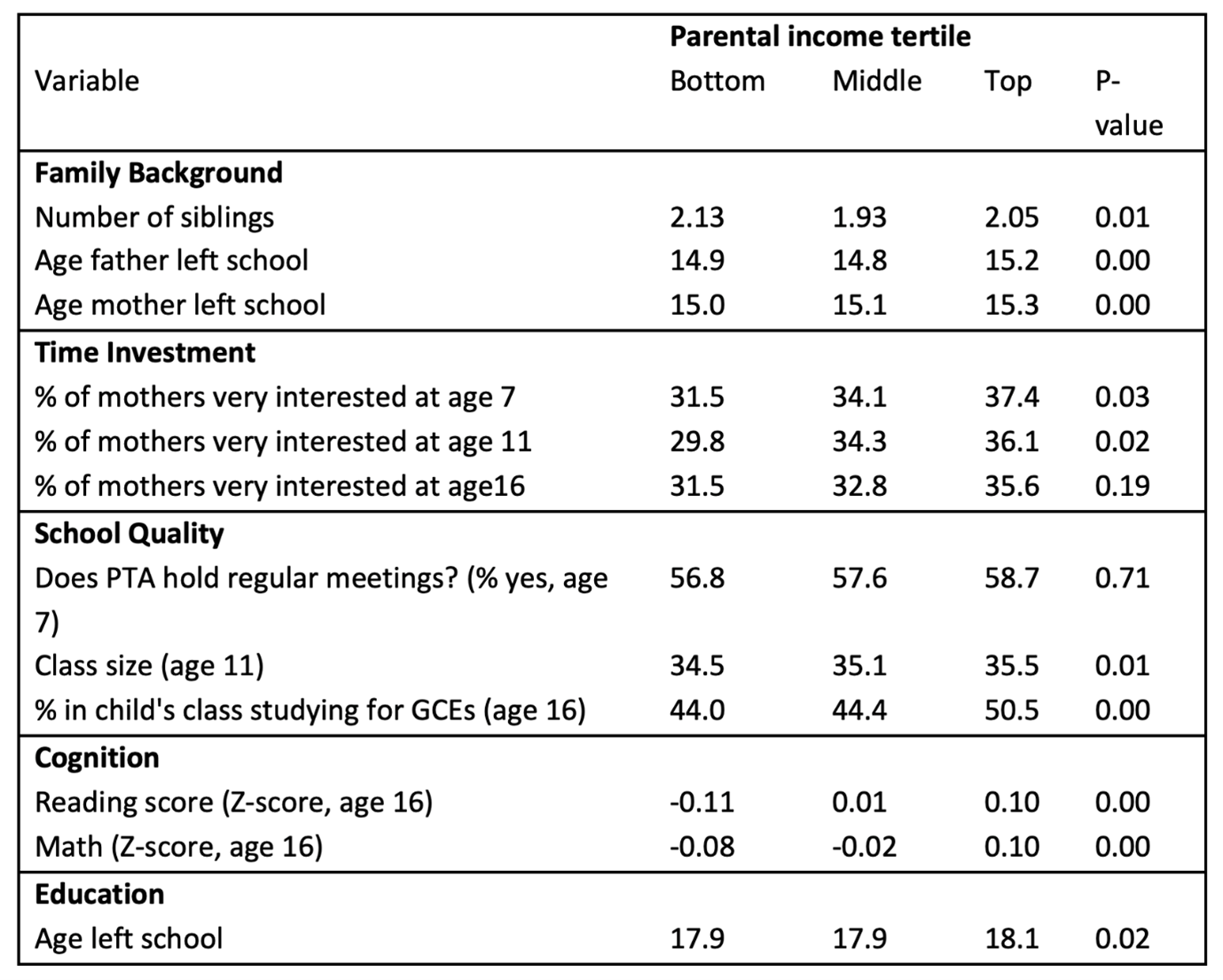
Table 1 shows gradients for some of our channels of interest by parental income tertile.  The table shows that children from high-income households have fewer siblings and more educated parents than those born to lower income parents. Teachers report that high-income parents are more interested in the education of their children.  Furthermore, children of high-income parents are more likely to go to schools where: parents attend educational meetings at age seven, student-teacher ratios are low at age 11, and a high fraction of students are doing GCEs at age 16 (an optional exam for progressing to further education).  As a result, children from richer households develop greater cognitive skills; at age 16, reading scores were 21% of a standard deviation higher on average for children with high-income parents compared to children with low-income parents.

Table 1 describes only a subset of the variables we use.  We combine these variables using a factor analytic approach to predict latent time investments, school quality and cognition, similar to Heckman et al. (2013).  The factor analytic approach allows us to use all measures available to us by treating them as noisy measures of school quality, parental time, and cognition.

Table 1 Sample means, by parental income

Table 1 Sample means, by parental income

Note: The final column reports P-values from the F-tests testing the null hypothesis of equality of means across parental income tertiles. The time investment measures are teacher-reported measures asked when the children are 7, 11, and 16. Teachers can evaluate parents as very interested, a little interested, not interested at all. We report the fraction of mothers and fathers who are very interested.

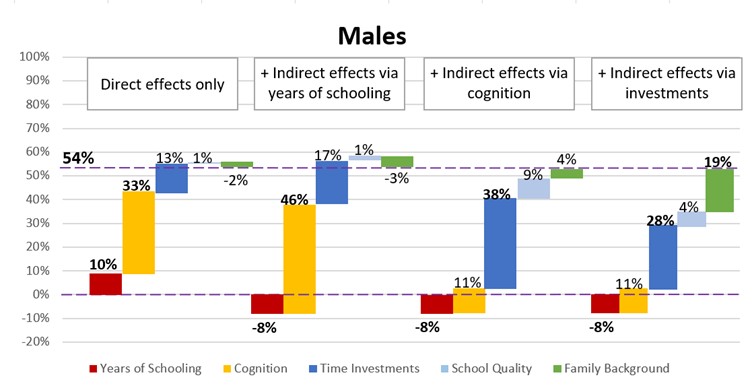
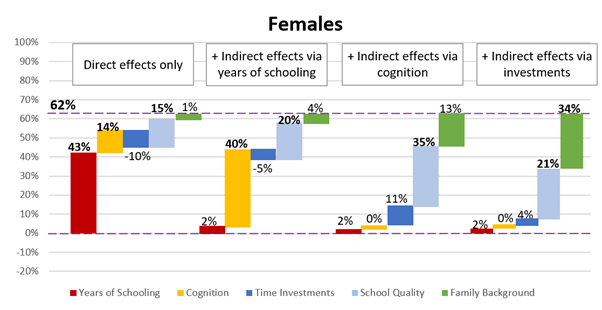
We find the intergenerational elasticity of earnings, or IGE (which is a measure of the relationship between parental and child lifetime income), to be 0.32 for men and 0.24 for women. The first part of Figures 1 and 2 shows the fractions of this relationship explained by differences in family environment, time investments, school quality, cognition at 16, and completed years of schooling when we only allow for direct effects of each variable on lifetime income. These variables explain over half of the IGE –– 54% and 62% for men and women, respectively (the remainder is explained by factors beyond the ones we consider, such as better job networks).

Figures 1 and 2 summarise the main for results for men and women respectively.

Figure 1

Figure 2

In the first panel of each figure, we find that years of schooling and cognition explain significant and large fractions of the IGE, both for men and women.  We then investigate whether schooling and cognition are driven by earlier life investments and family background.

In the second panels of Figures 1 and 2, we allow for indirect effects via years of schooling. For example, for cognition, we now additionally account for its effect on lifetime income via its effect on years of schooling. Doing so, we find that the fraction of the IGE that was previously explained by differences in years of schooling can actually be explained by differences in cognition, instead. This suggests that it is not parental income per se, but the higher cognitive levels of children of high-income parents that encourages higher educational attainment.

The next level of our analysis, illustrated in the third panel of each figure, addresses the sources of cognitive skills.  We allow for parental time investments, school quality, and family background to affect the IGE not just directly and via years of schooling, but also via cognition. We then find that the fraction of the IGE that comes from the cognition gradient can largely be explained by differences in time and school quality investments received during childhood. This is consistent with previous literature that has found significant effects of parental investments on cognitive development.

Lastly, we let family background – which comprises mother’s and father’s education, and number of siblings – have an indirect effect by affecting investments. Once we do so, family background explains 19% (34%) of the IGE for men (women). This contrasts with the zero effect of family background that we find in our baseline analysis. In other words, family background matters, but only because it affects investments, which then affect cognition and years of schooling. This result is consistent with Carneiro et al and Akresh et al. who find that increases in parental education lead to more favourable child outcomes. However, we also find that even if we control for family background, the remaining parental income gradient of investments explains 28% of the IGE. This suggests that higher parental income directly leads to higher investments in children, and not only runs through family background, a point which we have developed in greater detail in a forthcoming paper. This supports Bastian and Lochner’s (2021) conjecture that the increase in financial resources from programmes such as the Earned Income Tax Credit are what drives improvements in child outcomes.

Thus, we conclude that the main driver of intergenerational earnings persistence are differences in investments received during childhood which subsequently leads to improved cognition and more years spent in education.  Many of these investments, such as school quality, are the subject of public policy debate.  Our results suggest that policies that equalise these investments could improve income mobility.

The Intergenerational Elasticity of Earnings: Exploring the mechanisms, is research by Uta Bolt, Eric French, Jamie Hentall-MacCuish and  Cormac O’Dea.

‘Queer Millennials’ and ‘Gay Boomers’: Rethinking the Generational Narrative for LGBTQI+ Lives.

By Matthew Hall, Research Fellow with CILIA-LGBTQI+ at the University of Surrey

The media, policymakers and marketing organisations all love their generational labels. Over the last decade all-to-familiar terms like ‘Boomer’, ‘Millennial’, ‘Gen X, and now ‘Zoomer’, have come into popular use, narrowly classifying vast groups of people who share their formative years during the same approximate socio-historical period.

Recently, the credibility and use of these classifications have been rightly scrutinised. This is largely due to their non-empirical origins in consumer marketing strategies, their use as a political smokescreen and their tendency to overstate intergenerational conflict and pit social groups against one another.

Sensationalist and provocative headlines such as Why millennials’ distaste for Baby Boomers is justified”, “Our Weak, Fragile Millennials” and “Boomer v broke: why the young should be more angry with older generations” have become commonplace within a time when swathes of mainstream news outlets have become caught in a tide of propagating the so-called ‘Culture Wars’.

However, one equally relevant, yet often overlooked, concern is that these narratives tend to overstate shared generational experiences within each birth cohort. They disregard ways in which historically marginalised groups of people, such as those identifying as lesbian, gay, bisexual, trans, queer or intersex (LGBTQI+), may share completely different generational experiences, marked by completely different formative historical, social and political developments.

Our research conducted over the last three and a half years, as part of the CILIA LGBTQI+ (Comparing Intersectional Life Course Inequalties amongst LGBTQI+ Citizens in Four European Countries) project, highlights just how poor these marketing classifications are for understanding LGBTQI+ lives. The project undertook extensive lifecourse interviews with 48 LBGTQI+ citizens within England from an array of ages, social and regional backgrounds, ethnic identities, and dis/abilities. The results suggest that whilst there are some distinctive generational differences between those identifying as LGBTQI+, these do not map neatly at all upon traditional frameworks.

Firstly, socio-historical developments are often used to define generational cohorts – for instance, a dramatic population spike and increase in living standards typically marks the Baby Boomer generation. However, for our respondents, these were set against more LGBTQI+-specific social, historical, and political developments.

For example, the Stonewall riots of 1969 and subsequent decriminalisation of homosexuality across Western countries during the late 1960s and early 70s, as well as the introduction of civil partnerships and equal marriage, appeared far more formative for generations of LGBTQI+ individuals. Likewise, less-progressive developments such as Section 28 – restricting any promotion of homosexuality as a ‘pretended family relationship’ by UK local authorities (including schools) from 1988 until 2000 (in Scotland) and 2003 (in England and Wales) – also featured heavily as important generational markers with longstanding legacies.

Meanwhile, other events more specific to transgender and queer individuals, such as the Gender Recognition Act (2004) in the UK, were equally formative for their queer generational identifications. Even ostensibly universal socio-historical developments, such as the information age and widespread digital literacy, can be experienced differently based on one’s position and needs within society. For example, fairly recent concerns about the impact of digital technologies on the dating economy for Millennials and Zoomers, appears to ignore many gay men and women’s reliance on technologies (and previously newspaper ‘personals’) for the best half of a century. Perhaps ‘Gay Boomers’ were just Millennials ahead of their time?

Secondly, our respondents’ queer generational identifications did not always correspond with neat and discrete birth cohorts, nor shared turning of adolescence, as has come to be expected of generational groupings. When discussing the introduction of civil partnerships in 2004, a gay trans male respondent, who had been working in the armed forces, puts it aptly: “[…] civil partnerships came in, and you were allowed to marry and get married quarters and all that sort of stuff […] So, there was definitely changes, and people were a bit more open about it. But that didn’t really affect me because I wasn’t same sex attracted, and I didn’t understand the gender thing then. Like I say, I didn’t understand it at that point, so…”.

Cases like these raise the question as to whether queer generational cohorts may be better framed by when individuals first become self-aware of their same-sex attraction, begin questioning their gender identity, ‘come out’ to others, begin identifying with a wider LGBTQI+ community or when they enter ‘queer spaces’ for the first time. A 50-year-old who has only recently begun to think about themselves in terms of sexual identity, for example, may share more formative experiences with much younger LGBTQI+ individuals than with their own peers. As such, queer generations could be understood as the mutual phasing between queer-specific socio-historical developments and a personal queer lifecourse.

Overall, despite more recent social change, many LGBTQI+ lives remain outside of what we might think of as normative generational experiences. It is important that pervasive and universalising narratives about generational difference do not further marginalise queer lives and render them invisible. How we effectively talk about generations should account for both the diversity of LGBTQI+ lives and varied experiences of social, historical and political developments.

King, A. and Hall, M.A. (forthcoming 2022) ‘Re-thinking Generations from a Queer Perspective: Insights and critical observations from the CILIA-LGBTQI+ Lives in England project’, in H. Kingstone and J. Bristow (Eds.) Studying Generations: multi-disciplinary perspectives, Bristol: Policy Press. The book is part of the Bristol Policy Press open access series.

Nature, nurture and our later life outcomes: new insights on inequality over the lifecourse

In Episode 2 of Series 4 of the DIAL Podcast, we are in discussion with Professor Hans van Kippersluis from the Erasmus University in Rotterdam. Hans, Professor of Applied Economics, is the Principal Investigator on the DIAL project, Gene Environment Interplay in the Generation of Health and Education Inequalities, which has used innovative methods and data to explore the interplay between nature and nurture in generating health and education inequalities.


Transcript

Christine Garrington  0:00  
Welcome to DIAL, a podcast where we tune in to evidence on inequality over the life course. In series four, we’re looking at what’s been learned from some of the DIAL projects about how and when inequality manifests in our lives, and what its longer term consequences might be. For this second episode of the series, we’re delighted to be joined by Hans van Kippersluis, Professor of Applied Economics at the Erasmus University in Rotterdam. And Principal Investigator of the DIAL project, Gene Environment Interplay in the Generation of Health and Education Inequalities – put more simply nature versus nurture. So Hans, welcome to the podcast. And I wonder if you can start by talking us through what researchers working on this project have actually been looking into.

Hans van Kippersluis  0:42  
What we’ve been doing in this project is essentially incorporating the recent availability of genetic data into social science and most prominently economic analysis. And so most of our work has focused on the interplay between genes and the environment. So in the introduction, you mentioned nature versus nurture, but actually more accurately, what we’re doing is nature and nurture jointly into how they shape essentially education and health outcomes. And I think this is also the main innovation of our project, because biologists have studied nature before; social scientists have  of course, extensively studied nurture, but not many have studied the interplay, the interaction between the two. And I think this was sort of the main innovation for why we got the funding some five years ago. And so what we have done is mostly studying this interplay. But along the way, we have also made some methodological contributions to a field which is very new. Then we’ve also used genetic data to test all their theories, and also, I think, enrich the framework of equality of opportunity.

Christine Garrington  1:35  
Yeah, fantastic project. And as you’ve just said, you’ve made unprecedented use of genomic as well as survey data in the research, tell us a bit more about the information that you’ve been able to access? And how you’ve been able to use it?

Hans van Kippersluis 1:47  
Yeah, sure. So the interesting thing is that more and more social science datasets, so data sets that have been traditionally used by social scientists, and these are mostly extensive surveys,  are now collecting DNA information from their respondents. And this is often from blood or saliva. And what they did is basically, so more than 99% of DNA is the same across human beings. And so what we are using is only this remaining less than 1% of the variation. And these are called snips. And snips are points of your DNA that differ across human beings. And there’s roughly 1 million of them. And so what we do, basically also other people have done is sort of aggregating these tiny effect sizes into an index. And this is called the polygenic index. And this is telling us something about your genetic predisposition towards a certain outcome. And this is quite interesting, because this data, this new variable, essentially can be added to existing datasets. And so we have a wealth of information that has been collected in the past on surveys on existing data. And then we simply add one indicator, one new variable. This is telling us something about people’s genetic predisposition. And just to be clear, this is not like a deterministic variable. It also exhibits quite a bit of measurement error and noise. But at the group level, and that’s what we have been doing is it sort of does tell us something about your genetic predisposition, and it can help us understand how certain life outcomes like education, like health, are shaped by the interplay between your genetic predisposition and your environment.

Christine Garrington  3:07  
Indeed, let’s talk a little bit now then about some of the research findings. And you know, what’s come out of this now, one piece of research we’ve spoken about this actually, in an earlier podcast episode, actually drew links between mothers smoking in pregnancy and their baby’s birth weight. I wonder if you can just sort of summarise that for you what actually came out of that what we learned

Hans van Kippersluis 3:28  
this was work with with my PG students, Rita Dias Pereira and colleague Cornelius Rietveld . And for birthweight we knew that maternal smoking is one of the key environmental risk factors. And we also knew from genetic studies that genes matter in determining your birth weight. And so what we did here was essentially looking at the interaction between the two. So can higher polygenic indices protect against maternal smoking? And the answer, unfortunately, perhaps was no, in the sense that we found very, very little interaction between genes and the environmental exposure of maternal smoking. So it seems that both matter, but there doesn’t seem to be any meaningful interaction between the two. So that was, to some extent surprising, but on the other hand, also perhaps logical in the sense that maternal smoking is apparently such a devastating environmental exposure that even higher genetic predisposition cannot protect you from this.

Christine Garrington  4:16  
Yeah, really interesting. And anybody who’s interested in that can listen to Rita actually discussing that in series three, Episode Seven, of our DIAL podcast called Mums Who Smoke and their Baby’s Birthweight. So do check that out if you’re interested to know a little bit more about what Rita and all of the all of your colleagues did. Now, there have been some interesting findings Hans from the project around the role of genes in a child’s education and specifically around parental investments. I wonder if you can explain a bit more about what you were looking to understand there. 

Hans van Kippersluis 4:50  
Yes, yeah, so this is one of my favourites studies. It’s joint work. Also with another PG student   Muslimova and my colleagues Stephanie von Hinke, Cornelius Rietveld and Fleur Maddens. And the starting point there was actually a theory of human capital formation from economics. And it dates back all the way to the work of Nobel laureate Gary Becker. And one of the crucial assumptions in that model is that parental investments are complementary to your genetic endowments. And this assumption is actually very hard to test because often we do not have a good measure of endowments. And if we do, it may already be contaminated by parental investment. So many people, for example, use birth weights. But of course, well as we just learned, maternal smoking may have a large effect on your birth weight, so it’s not fully free of your parents’ behaviour. And the other thing is that your parental investments often respond to endowments. So if you have a child with specific needs, of course, parents respond to this. So the problem of testing this assumption is that endowments and investments are actually always very closely entangled. And that makes it very hard to test whether they are complementary or not. So what we did here was using one’s genetic endowment, and that is actually has a very nice property and that it’s fixed at conception, so it cannot be affected by your parental investments. And what we did was using the child’s birth order to proxy for parental investments. So what we know from earlier studies is that firstborns tend to get more parental attentions on average than later points. So this is one after all, because they have undivided attention until the arrival of later borns. And this extra parental investment is actually independent of your endowments. It simply derives from the fact that you have more time if you have one child as opposed to multiple children. So what we did in this study is looking within families comparing siblings that were first born to later borns, and then further analysing whether this firstborn advantage was stronger for firstborn siblings who randomly inherited the higher polygenic index for educatio. I think this was a nice, very unique setting to test this theoretical assumption that parental investments are complements to genetic endowment.

Christine Garrington  6:45  
What did you find here? Then what do we learn about the role of genetics in affording in affording certain children advantages later on in life?

Hans van Kippersluis 6:53  
So what we found was that indeed, the firstborn effect seems to be stronger for siblings who randomly inherited higher polygenic indices. And I think this is evidence in favour of this theoretical assumption of complementarity between endowments and investments. And it also means that your genetic predisposition cannot just give you a direct advantage. But it also means that this advantage may be kind of amplified by your parental or your teacher investments. And this complementarity, I think also suggests once again, that for disadvantaged children, so the other side of the coin, we need to start very, very early and follow up these early investments also with data investments to make them as productive as possible.

Christine Garrington  7:29  
So Hans, some fascinating research and findings. I wonder if there’s been a standout or surprising finding for you from the project. 

Hans van Kippersluis 7:36  
I  think methodologically, what we’ve learned is that there’s still a world to explore in terms of using genetic data in social science, because what we have seen is that polygenic indices can be a great tool to improve our understanding of the things we just talked about. But I think the way we use these polygenic indices, are shall I put this sort of a bit naive, in some sense, because what we do is we first construct a score or an index by regressing an outcome on all of these 1 million individual genetic variants. And as you can imagine, if you do these 1 million regressions, then it will be a lot of noise in  these coefficients, and these estimates also come with some uncertainty. And what is surprising to me, what I’ve learned is that many researchers simply sort of seek to use this polygenic index as if it’s some kind of a transferable and deterministic index. And there’s hardly any account in the literature on the uncertainty in this index. And I think what we have done in one paper is actually showing how this uncertainty is sort of leading to different conclusions, because what we did is basically looking at the polygenic index for cardiovascular disease. And in cardiovascular disease, more and more people are using these polygenic indices, this genetic data for personalised decisions regarding, for example, the use of statins. And what we did was sort of constructing six different polygenic indices using different discovery sample using different methods of constructing this polygenic index. And what was fascinating and actually maybe astonishing to see is that only 6% of the individuals are in the top quintile of the polygenic indices, if you look across these six different ways of constructing the same polygenic index. And I think this is fascinating, because it shows that even though polygenic indices are now increasingly being used, apparently it matters a great deal about how you construct these things. And this is one thing we have shown, I think this is quite remarkable, and also an important methodological contribution.

Christine Garrington  9:19  
A really important contribution to how this research might develop in the future. Right, absolutely. And then just finally, Hans, I wonder what this all of this work tells us about the interplay between genes in our environment, or, as we’ve talked about nature and nurture, not nature versus nurture, in better understanding and in tackling inequality.

Hans van Kippersluis 9:41  
So it’s very hard, I think, to give sort of direct policy leads or implications, but there’s a few leads. One thing is that I think we need to start early. We knew already that inequalities arise early in life. And I think this focus on genetics gives us yet another clue that it’s very important to start early. And also because of the work I mentioned about complementarities, it’s very clear that later investments are more effective if the person has had already more investments early in their life. So that’s clearly one more general policy implication, I think. And I think our work is also showing how sort of genes and environment shaping jointly inequalities. And I think this has important implications for the discussions about equality of opportunity. I mean, if you look at politicians across the entire political spectrum, everybody seems to be agreeing that equality of opportunity is a great thing, and that your health and your income should not depend on your parental background. But let me ask two questions about this. One is, what about your genes? There’s hardly any discussion about whether inequalities that are deriving from genetic advantages or disadvantages are fair or not. And what we’ve also shown in this project is that parental background seems to reinforce genetic advantages. So even if you believe that parental background should not be leading to inequalities and your genes may, then how do you treat the interaction between the two? So I think we should have a clear discussion here a societal discussion about what is fair here. And I think that’s why our research is very important, because 30 years studies have already shown that people’s preferences for redistribution, for example, depends strongly on whether they perceive inequalities as fair or unfair. So I don’t think we are political activists here. But I do think that showing how genes and the environment jointly shape outcomes such as health, education, income, but really help people to make up their own mind as to what they regard as fair or unfair inequalities.

Christine Garrington  11:23  
Hans thank you very much some some big advances here. But still some big questions to answer, I guess is the is the summary but fascinating work and thank you for taking time to share it with us. So finally, thanks to Hans van Kippersluis  for discussing the findings and implications of DIAL dial project Gene Environment Interplay in the Generation of Health and Education Inequalities. You can find out more about this and other dial research on the website at www.dynamicsofinequality.org. We hope you enjoyed this episode, which is produced and presented by me Chris Garrington of Research Podcasts. And don’t forget to subscribe wherever you find your podcasts to access earlier and forthcoming episodes.


The long-term effects of school closures

by Alexander Ludwig and colleagues

This blog was first published by VOXeu.

After the outbreak of the COVID-19 crisis in the spring of 2020, politicians around the world closed schools and child-care centers together with businesses in an effort to contain the virus. According to the World Bank, around 1.6 billion school children were affected by these closures at their peak. While the economic costs of closing businesses arise immediately and are thus very salient, closed schools and child-care centers have negative economic effects on the human capital accumulation of children that only arise in the long run. Education is a crucial determinant of future wages, and schools are an important driver of intergenerational mobility. In the short-run, parents, and especially mothers, are struggling with combining work and child care while schools are closed, but what are the long-run economic impacts of Covid-related school closures on the affected children? 

A model of schooling and parental investment into children

To answer this question, we build a model that features public schooling as input into the human capital production of children, as well as monetary and time investment of parents into their children. At the core of the model, there is a human capital production function that features self-productivity, i.e. human capital builds on itself, and complementarity, i.e. the higher the human capital, the more productive is investment into human capital (Cunha and Heckman, 2007; Cunha, Heckman and Schennach, 2010). 

From age 4 to age 16 children reside with their parents who invest time and resources into their education, which, combined with public expenditures, governs the evolution of human capital of the children from kindergarten through high school. At the age of 16, high-school students decide whether to stop schooling and start working, to complete high school, or to obtain a college degree. At that time parents endow their children with intra-vivo transfers that can be used to finance higher education. The terminal school degree (college, high-school, high-school dropout) as well as the human capital accumulated during their schooling period determines wages of the children once they enter the labor market. 

We calibrate the model to data from the US. Parents are heterogeneous with respect to marital status, education, income, and assets. Parental characteristics affect not only the innate ability of their children, but also the optimal investment into their children. We model the school and child-care closures as a drop in governmental investment into children corresponding to school closures of six months. In addition, the COVID-19 shock comprises a fall in parental income through increased unemployment, with a larger incidence for less educated parents. We then use the model as a laboratory to ask how parents react to these shocks, and what are the ultimate labor market and welfare effects on the children? 

Our main results are summarized in Table 1. We find that the children affected by the school closures suffer long-run average wage losses of -1%. These wage losses lead to a reduction in welfare corresponding to a consumption equivalent variation of -0.7%. An important driver of the long-term wage losses are changes in the final educational attainment of the children; the table summarizes the percentage point changes in the education shares. Translated into percent changes, the share of college educated children falls by -2.6%, and the share of high school drop-outs increases by 4.1%, due to the fact that the children impacted by COVID-19 school closures early in their life arrive at age 16 with significantly less human capital than in the absence of COVID-induced school closures.

Thus, there are significant permanent negative effects associated with a purely temporary shock. For the children, the negative effects of the temporary school closures are much more important than the negative effects caused by the temporary income drop of their parents: school closures account for 90% of their overall welfare loss.

Table 1: Aggregate Outcomes of School Closures and Income Recession

Baseline change for children of biological age
average 4 6 14
change in %p
share s=no 12.15% 0.50 0.56 0.67 0.31
share s=hs 54.53% 0.38 0.27 0.32 0.43
share s=co 33.32% -0.88 -0.83 -0.99 -0.74
change in %
PDV gross earn $784,196 -0.99 -0.96 -1.19 -0.77
CEV children -0.70 -0.72 -0.84 -0.54

These negative effects emerge despite the optimal efforts of parents to offset the impact of school closures by increased parental time and resource inputs into their children’s education. On average, parents increase their time investment into children by 3.8%, and their monetary investment by 5.1%. However, due to their own income loss, parental intra-vivo transfers fall by -0.3%. These changes imply welfare losses of -0.3% for the parents themselves.

The average long-term gross earnings loss of -1% for the children translates into a net earnings loss of -0.8%, assuming no changes in the tax and transfer system. Given the progressivity of labor income taxes, the lower average earnings lead to disproportionally lower tax payments. Thus, while the tax system to some degree shelters children from the future negative income effects, the flip side is that future government revenues fall by more than the gross earnings loss endured by these future workers, namely by -1.8%. Thus, COVID-19 school closures in the short-run foreshadow a substantial fiscal crisis in the long run.

Younger children and children from disadvantaged households suffer more

The earnings and welfare effects of the school closures depend significantly on the age at which they happen. For children aged 6 who are about to start primary school when the COVID-19 school closures occur, long-term earnings losses amount to -1.2%, with associated welfare losses of -0.8%. By contrast, for children aged 14, these losses are approximately one third lower, amounting to -0.8% and -0.5%, respectively. The reason for this age pattern is that human capital builds on itself, and lower human capital leads to lower optimal investments in the future.

Thus, for children aged 6, parents optimally increase their investments at the time of the closures but cannot completely offset the human capital loss on impact. This leads to lower parental investments in future periods, relative to a world without the school closures. Compared to children of age 6,  younger pre-school children are somewhat sheltered from the negative effects of the closures, because at that age parental investments play a more important role for human capital accumulation than governmental investments. 

In addition to the age of the child, parental characteristics are a crucial determinant of the magnitude of the earnings and welfare losses for children from the COVID-19 crisis. The welfare losses of the school closures for children are decreasing in parental education as well as in parental assets. Well-to-do parents have more resources to help out their children during the school closures, and also have a higher incentive to do so.

Their children have on average higher human capital than the children of less well-off parents, and thus, given the complementarity of investments and human capital, larger investment increases after the school closures subside are optimal for them. Therefore, the role of parental characteristics for the school success of children is amplified by the COVID-19 school closures.

Prolonged school closures make the effects worse

The current second Covid-19 wave in the fall of 2020 makes prolonged school closures a reality in some school districts, and renewed school closures a possibility in many more. We find that the welfare effects of one-year school closures are more than twice as large as the welfare effects of six months school closures. The loss in schooling and associated human capital accumulation is harder to offset the longer the crisis lasts. 

Hybrid and digital teaching

Many schools relied on various forms of digital teaching during the school closures, and nowadays implement hybrid teaching formats, combining in-person instruction and remote teaching. The literature thus far provides only scant evidence on the effectiveness of online vs. in-person instruction, and thus it is hard to gauge the long-run consequences of digital teaching.

Yet, there is evidence that children from disadvantaged households have less access to and/or make less use of digital forms of teaching during the current crisis. Opportunity insights reports that student participation in online math work decreased immediately for all children at the start of the school closures, but ultimately decreased by 41% for children from low income ZIP codes by the end of the school year compared to January 2020, by 32% for children from middle income ZIP codes, and not at all for children from high income ZIP codes.

It is plausible that both the equipment for digital teaching among teachers, as well as the equipment and the provision of quiet learning spaces for the students depend on socio-economic characteristics. While we cannot put hard numbers on the differential use of online learning by parental characteristics, our model allows us to trace out the heterogeneous wage and welfare effects, by parental background, when the length of school closures is negatively correlated with socio-economic characteristics of the parents.

For example, if one assumes that the school closures in combination with distance learning opportunities correspond to a complete school closure of 3 months for children of college educated parents, but of 6 months for children of high school dropouts, then the welfare impact is -0.7% for the latter group, but only -0.3% for the former group.

Conclusion

School and child-care closures have significant negative long-term consequences on the human capital and welfare of the affected children, especially those from disadvantaged socio-economic backgrounds. This reduction in human capital accumulation is likely slowing the long-run growth prospects of countries, especially those whose economies are relatively human capital intensive, such as the U.S. and Europe.

Thus, school and child-care closures are potentially very costly measures to avoid the spread of the Covid-19 virus. This point was initially largely lost in the political debate, likely because these negative effects arise only in the long-run and thus are not immediately measurable. Medical research now also indicates that children are not the primary drivers of the COVID-19 pandemic, in contrast to pandemics caused by the influenza virus.

During the current second wave of the crisis in the fall of 2020, governments seem more committed to keep schools and child-care centers open as long as possible. For example, Germany and France are closing restaurants, bars, and the entertainment industry during their “lockdown light” in November 2020, but not schools and child-care centers. Our research suggests that this policy choice has the potential to pay significant long-run dividends for future generations, even though it might contribute to a more rapidly evolving second wave of Covid-19 infections in the short-run.

The Long Term Distributional and Welfare Effects of Covid-19 School Closures, by Nicola Fuchs-SchündelnDirk KruegerAlexander Ludwig and Irina Popova, was published by the Centre for Economic Policy Research in August 2020: CEPR Discussion Paper 15227.